
Anthony the Great
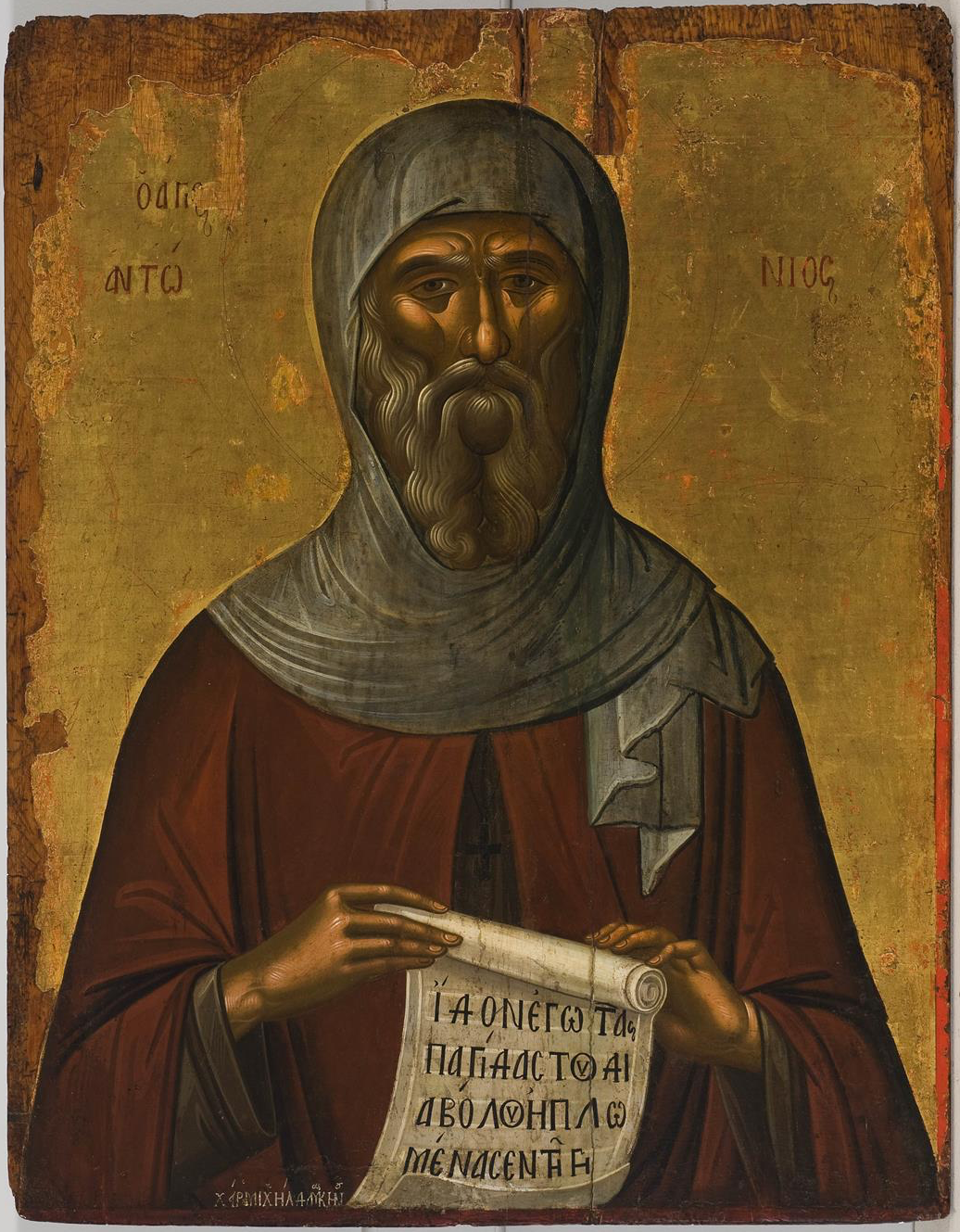
Anthony the Great was born in Koma (in Lower Egypt) in 251 to Christian landowning parents. His parents died when he was around 20, leaving Anthony and his sister to take care of their large estate. But when he heard Matthew 19 read in church, where Jesus instructed a rich young man to sell his possessions and give the money to the poor, Anthony was so moved that he did just that: he gave about 120 acres to his neighbors and sold the rest, giving the proceeds to people in need. He got rid of all his possessions and even placed his sister in the care of a “house of virgins” (likely an early Christian nunnery).
Freed from the burden of everything he ever owned, Anthony became a hermit. Though he was not, as some claim, the first Christian monk, his influence in the spread of early Christian monasticism cannot be denied. He was committed to strict asceticism: he lived in the desert west of Alexandria for over a decade, and subsisted only on bread, salt, and water. Eventually, Anthony decided this life was a bit too cosmopolitan for his tastes and decided to really retreat from the world. He settled on a mountain (called Pispir) east of the Nile, where he lived alone in an abandoned Roman fort for two decades. It was here that he faced his famous temptation (vote him on for more deets!). Despite his best efforts, Anthony developed something of a following. Pilgrims would come to visit and throw food to him over the wall. A community of ascetics formed in the nearby caves, and after 20 years, he emerged and began to teach them.
He eventually moved on once more, and at about 62 years of age settled on Mount Colzim (southeast of Cairo). He lived there for 45 years, during which he would receive visitors and occasionally travel across the desert back to Pispir. He died in 356, at the tender age of 105.
While he was something of a celebrity monk during his lifetime, his popularity and influence only grew after his death. This was partly because Anthony had the good fortune to meet and befriend one Athanasius of Alexandria, who wrote a hagiography of Anthony shortly after his death, which became whatever the premodern equivalent of a New York Times Bestseller is. Think of it like The Shack of its time, especially because it’s easy to picture Anthony living in one.
Anthony also goes by a good number of names, including Anthony the Great (not, it turns out, a family name), Anthony of Egypt, Anthony the Anchorite, Anthony of the Desert, and the Father of All Monks, just to name a few.
— Ian Lasch
Collect for Anthony the Great
O God, as you by your Holy Spirit enabled your servant Antony to withstand the temptations of the world, the flesh, and the devil; so give us grace to follow you with pure hearts and minds, through Jesus Christ our Lord, who lives and reigns with you and the Holy Spirit, one God, for ever and ever. Amen.
Paul of Thebes
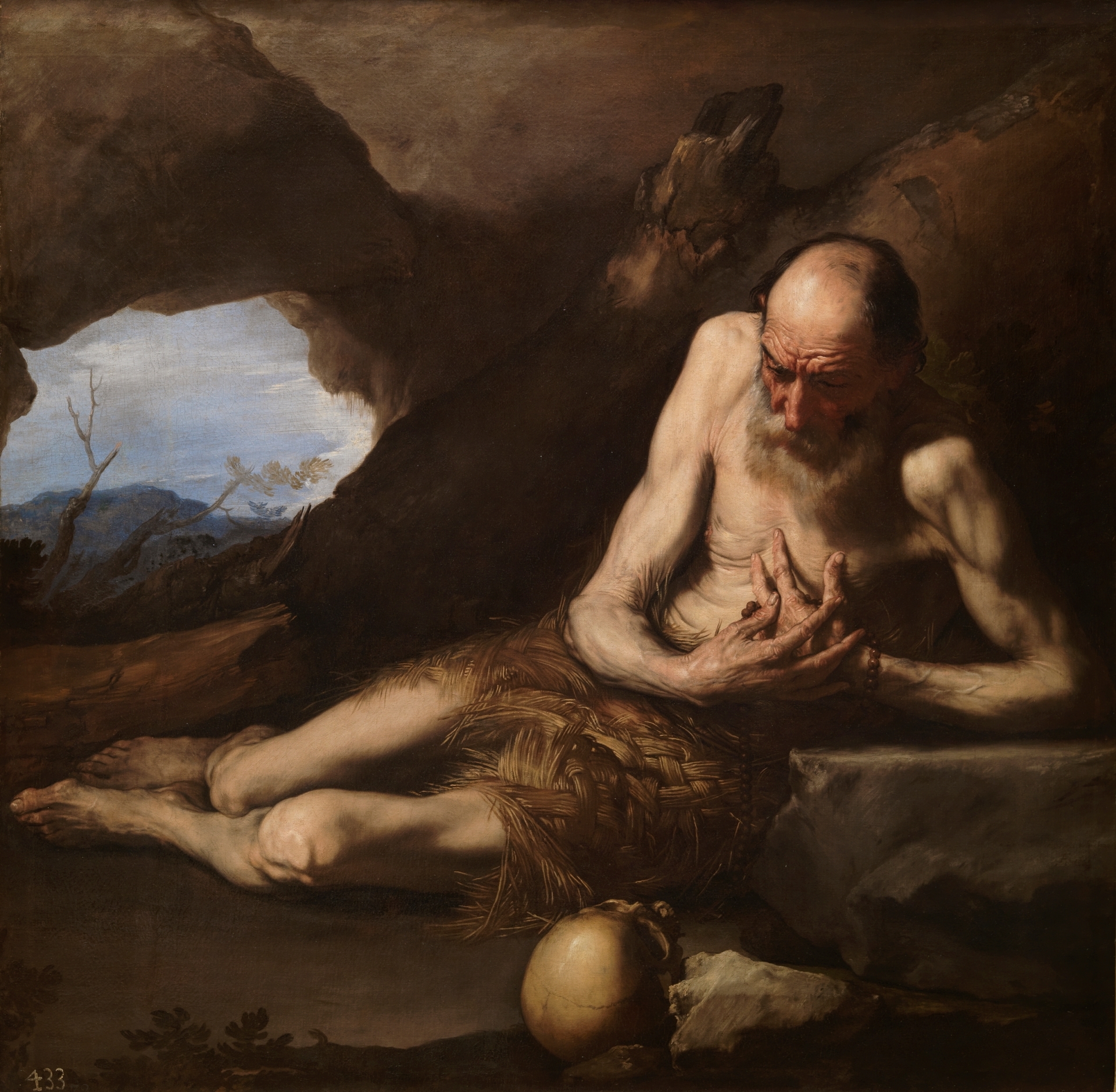
He is known as Paul of Thebes, or Paul the First Hermit, or Paul the Anchorite. No matter how he is known, Paul’s contributions to Christian life are far-reaching and deeply spiritual. Paul is considered the first Christian hermit, kicking off a lifestyle grounded in faith and prayer.
Paul was born in Egypt in 227 and died at an amazing age of 113 in Thebes.
Orphaned and caught in the middle of a family dispute, he trekked to the desert of Thebes at 16 years old during the persecution of the Roman Emperors Decius and Valerianus. He lived in a cave, relying on nearby resources for food and water. Then, at 43 years old, as the story goes, a raven started to bring him daily bread.
Paul lived a solitary life. However, he welcomed a significant visitor around 342, from Anthony the Great, who was following instructions from his dream to find Paul. They shared bread, prayers, and blessings.
As they met near the end of Paul’s life, he shared his burial wishes. Tradition says Anthony was aided by two lions who dug the grave with their claws.
Many followed his way of life. The Order of St. Paul the First Hermit was founded in Hungary in his honor in the 13th century.
Paul is the patron saint of the Roman Catholic Diocese of San Pablo in the Philippines, where the cathedral is sanctified for him. The Monastery of Saint Paul the Anchorite, near the Red Sea, is a major pilgrimage site.
In the Episcopal Church, St. Paul in the Desert in Palm Springs, CA, is named for him.
Paul was canonized in 491. His feast is celebrated on January 10 by the Roman Catholics, January 15 in the Anglican Communion and the Eastern Orthodox Church, and February 9 in the Coptic Orthodox Church.
Paul is the patron saint of children, based on a 15th-century tradition of miracles occurring through intercession to him. As such, the Pauline Fathers still bless children on his feast day.
He is featured in The Life of St. Paul the First Hermit by St. Jerome of Stridon, and in three YouTube videos: The Story of Saint Paul the First Hermit; Saint Paul of Thebes & Saint Alexius of Rome; and Saint Paul of Thebes Saint Story for Kids.
Paul is symbolized by a palm tree, two lions, and a raven.
— Neva Rae Fox
Collect for Paul of Thebes
Saint Paul the Hermit, lover of silence and faithful servant of God, teach us to seek the Lord above all else. Help us detach from worldly distractions and grow in prayer, trust, and holiness. Pray for us, that our hearts may always rest in God. Amen.
97 comments on “Anthony the Great vs. Paul of Thebes”
If Paul was born in 227 and lived to be 113, then he welcomed no one in 342, unless they came to venerate his corpse. Math errors aside, his bio seems padded for length to me.
I’m not as bothered by Anthony’s treatment of his sister as most seem to be. Firstly, I suspect “their” estate was actually his. We also have no idea what her being in the care of a place meant, and we don’t know how much input she had in the decision. Some are contrasting this with Paul being the patron saint of children, but that happened eleven centuries after his death. I can certainly say Paul had one of the more active afterlives I’ve read about!
In the end, it seems Anthony actively chose his life, and Paul escaped into his. I don’t think either should get the golden halo, but I’m going for Anthony today.
I see where so many went against Anthony because he placed his sister in the care of a Nunnery. At the time this would have been the norm. We were not enlightened on her age so she may not have been of age to marry. I know today we often judge on today’s standards. Even as a hermit he built a following and he did this more than once.
I'm more concerned about the "leaving her destitute" part than the nunnery part, tbh.
Paul of Thebes! The grave-digging lions did it for me.
Anthony abdicated responsibility for his sister!
Really, Anthony the Great "gave his sister to a house of virgins." How do you "give" a sentient human away? I understand the sensibility of the time to view women as property and can excuse it but do not choose to honor it.
For many women in the ancient world, a life of celibacy saved them from the very real dangers of pregnancy and childbirth, as well as from serving as household servants to their husbands. Many of the women we honor in the Church from that time had freedom of intellectual pursuits that would not be allowed a wife and mother.
I’ve never understood how being a hermit serves God but I can’t argue with a raven and a lion. Paul got my vote.
Have to admit I’m not inspired by people who withdraw from other people and starve themselves. Not sure how that helps to spread God’s word. This isn’t the most compelling matchup for me
I don't suppose Anthony asked his sister if she *wanted* her home sold and to be put in a nunnery before he went ahead and did it?
I think people are being a little harsh towards St. Anthony for how he treated his sister. We don't know for sure that she didn't want to join the nunnery. Maybe God called her to monasticism, too. The other option would have been to marry her off, so maybe she did want to join the nunnery.