Welcome to the first matchup of the 2026 Saintly Smackdown! Join Fr. Christian and Fr. Michael for a fast, fun season preview as they break down a few favorite matchups and set the stage for another wild ride toward the Golden Halo:
And now to decide between our first pair of saintly competitors...
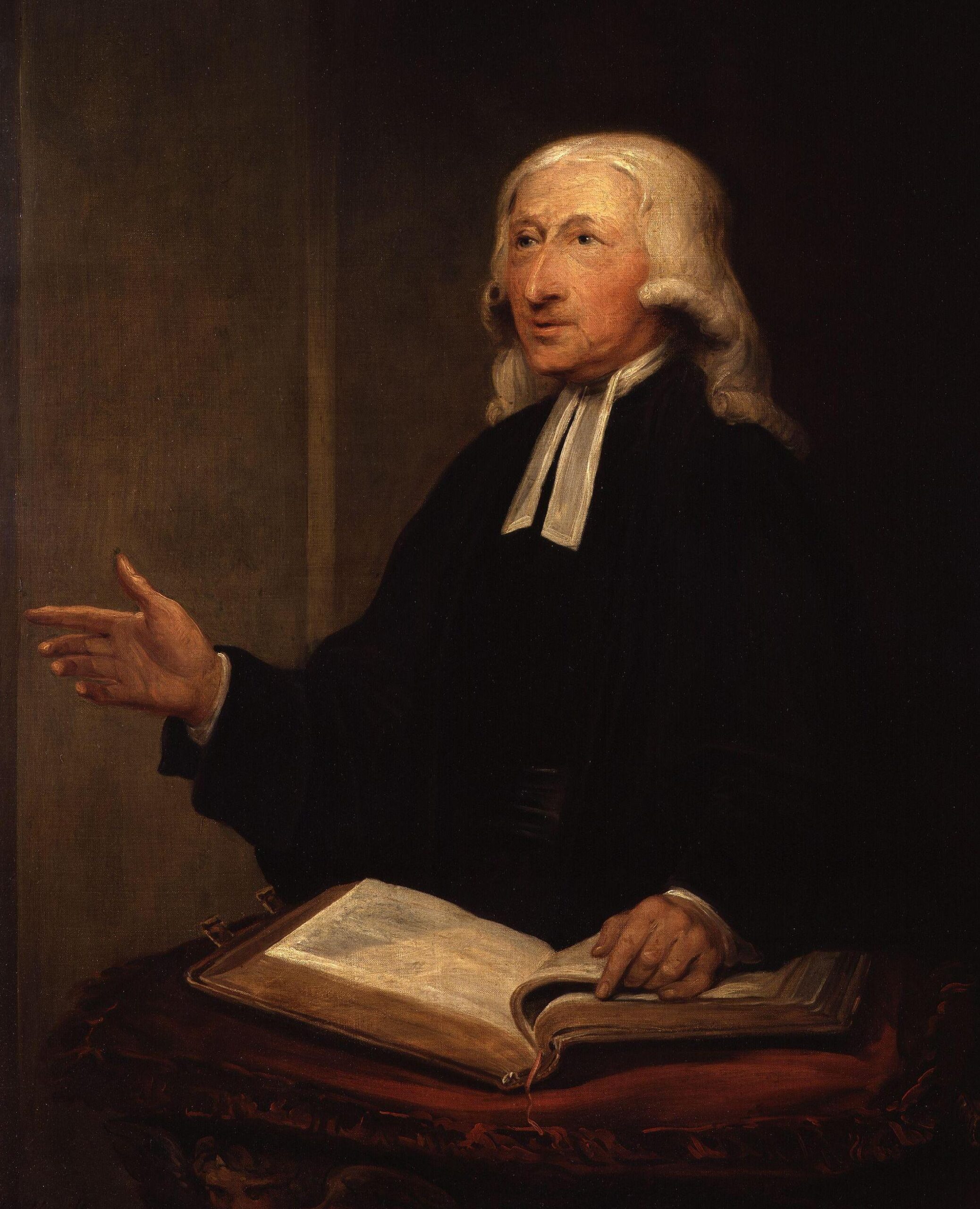 John Wesley was born in Epworth in 1703 as the 15th (!) child of his parents. His family tree already had many a cleric in its branches. He was educated by his mother Susanna until age 11, then attended boarding school and later Oxford, where he formed and led an organization known as the Holy Club. While the name was likely given to mock him and his cohort as religious fanatics, John Wesley came to take holiness quite seriously. He was profoundly influenced by William Law’s A Serious Call to a Devout and Holy Life, and ordained an Anglican priest in 1728. He would in turn come to exercise a profound influence on the Church.
But first, he would experience colossal failure. He traveled to Savannah, Georgia, to be part of the life of the newly established colony. En route, he encountered two things that would have a lasting impact on his life and ministry: Moravians and a young woman named Sophia Hopkey. The Moravians helped shape his theology, and Sophia captured his heart. However, when he later took advice to break off the relationship, he neglected to mention this to her. She then married another man, and when she eventually attended church again, John denied her Communion. This caused a scandal, and John was placed on trial. He fled back to England after only a couple short years in Georgia.
It was at a Moravian meeting that John’s heart was strangely warmed in his famous Aldersgate conversion experience. He began preaching publicly outdoors but eventually drifted away from the Moravians and formed the Methodist Society. The Methodists, under John’s leadership, allowed lay people to preach and refused to be confined by parish boundaries, both unpopular choices among the religious establishment of John’s day. But their willingness to do what they thought needed to be done, rather than only what the church would permit, led to significant growth in attendance and piety among the budding Methodists, even as it strained relations with the Church of England. When the Bishop of London refused to ordain a Methodist to be sent to the United States following the American Revolution, John Wesley ordained Thomas Coke as a superintendent and a number of others as presbyters, leading church officials to ask, “Wait, can he do that?” and likely cementing the division between the Methodist Society and the Anglicans. John, however, remained an Anglican until his death in 1791.
While portions of John’s life may not be the sort of thing we want to emulate, his influence on the church cannot be denied, and his serious and methodical approach to holiness can have tangible benefits for those who would like to take sanctification seriously.
— Ian Lasch
Collect for John Wesley
Lord God, you inspired your servants John and Charles Wesley with burning zeal for the sanctification of souls and endowed them with eloquence in speech and song: Kindle such fervor in your church, we entreat you, that those whose faith has cooled may be warmed, and those who have not known Christ may turn to him and be saved; who lives and reigns with you and the Holy Spirit, one God, now and for ever. Amen.
Martin Luther
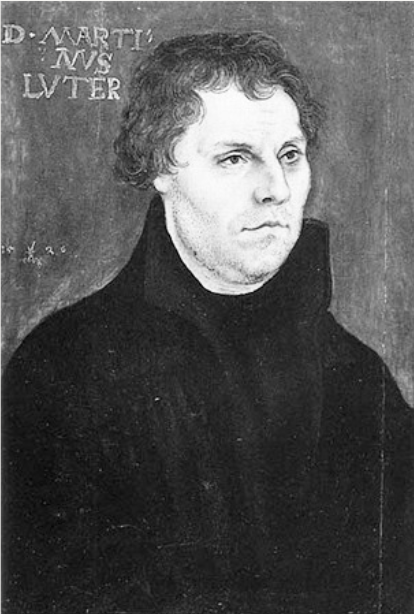 Priest, theologian, teacher, and excellent list-maker, Martin Luther strove to reform the church he knew, and in the process, reformed the Western Church for all time.
Born to Hans and Margarete Luther in 1483, Martin grew up in what we know now as eastern Germany. Martin succeeded in school early on, and went to the University of Erfurt. His father wanted him to become a lawyer, but Martin felt called to the church, becoming an ordained Augustinian friar in 1507. (He doesn’t seem to have been excited about this decision, and described the period pursuing ordination as a time where he had lost contact with Christ the Comforter of his Soul.)
His superiors, worried about him, assigned him to further theological work and teaching, reasoning that this would prevent Luther from further excessive rumination. It only partly worked. Luther continued to excel in theology, teaching at the University of Wittenberg, and receiving his doctorate in 1512. He continued teaching at Wittenberg for the rest of his life.
While he was teaching at Wittenberg, Luther studied the Psalms, Hebrews, Romans, and Galatians. It was then that he became convinced that salvation was utterly and entirely a gift of God’s grace. Faith, he argued, is something God gives to the believer rather than a work of human will.
Around the same time, in 1516, Rome sent a Dominican friar to Germany to raise money to rebuild St. Peter’s Basilica by selling indulgences. This did not please Martin Luther. He wrote a lengthy letter to his bishop, listing out his objections in detail. This letter was translated and circulated among the towns in Germany, and became known as the 95 Theses.
Luther’s arguments (that the Church should not be charging money for forgiveness of sins, since only God could do that; that the Pope had more than enough money on his own to build buildings; that the Pope and church councils do not have the right to override Scripture and are not infallible; etc.) had been made before. But because of the printing press, the increasing unrest among the peasant class, and now some support among the German nobility, his writing ended up launching what became the Protestant Reformation. Luther was excommunicated by the pope in 1521, but continued his preaching and teaching under the protection of the secular rulers of the area.
By the time he died in 1543, he and his compatriots had laid a firm foundation for a new way of experiencing Christianity and a more gracious way of being in relationship with God.
— Megan Castellan
Collect for Martin Luther
O God, our refuge and our strength, who raised up your servant Martin Luther to reform and renew your church in the light of your word: Defend and purify the church in our own day and grant that, through faith, we may boldly proclaim the riches of your grace, which you have made known in Jesus Christ our Savior, who with you and the Holy Spirit, lives and reigns, one God, now and for ever. Amen.
163 comments on “John Wesley vs. Martin Luther”
Correction re Wesley: "Superintendents" are not and were not _ordained_, simply appointed. And mentioning Coke but not Francis Asbury?
Interesting choice to focus on John's early struggles instead of the historically attested influence of his ministry, both in the United Kingdom and America.
Disappointing.
Music is important for me in worship, and the Methodists are known for their hymns. But even though Luther's hymns were used by Bach - no less! - in his cantatas, I have to vote for Wesley.
Lent Madness always presents these difficult choices, and here we are with a very tricky one on day 1.
Happy Lent, everyone!
How do I get the match ups to vote on in my email?
I polled my EfM class on this choice. One for Luther, former Lutheran. One for Wesley, because Luther was so anti-semitic. Is it just me, or is it strange that Martin Luther the racist became the namesake for the great American non-violent anti-racist martyr?
Oh, he had me at "excellent list-maker." I bet if spreadsheets had been available, he would have shared my motto, "Oh, that calls for a spreadsheet!" How better to organize and cross-reference his theological arguments!
The site will not allow me to vote…
I want to know more about John and Sophia! a soap opera in the making......
Really, really tough choice. This ex-Methodist, current Episcopalian still had to vote for Luther.
I voted for Martin Luther every single round when he was in Lent Madness 2017. I could not believe he was not awarded the Golden Halo on the 500th anniversary of posting the 95 theses. I voted for John Wesley today.
John Wesley didn't start a war that went on for thirty years and killed millions. He also didn't advocate for violent repression of the poor to maintain order for the elites. Oh, yes, and as others pointed out, he was sexist (boooooo!), but he wasn't an antisemite. Yeah, I'll go with Wesley.
I can't vote on my upad. It lets me say I am not a robot but won't let me select my choice. (Both of which are excellent and are hard to choose from.)
AS a womb-to-tomb Methodist, this was a no-brainer choice for me.
Each year Lent Madness is incorporated into my personal devotion time.
Despite Luther's impact on the reformation, I voted against him based on his strong words in condemnation of the Jews in his treatise "On the Jews and Their Lies." We do need to remember both the faithful actions and failures of religious leaders of the past (and present).
As a womb-to-tomb Methodist, this was a no-brainer for me.
Every year, I look forward to using Lent Madness in my personal devotion time throughout the season of Lent.
Well, since I have bobbleheads of Martin & Katerina, I have to vote for him.
Happy Lent!
I surprised myself by voting for Luther, a decision based solely on today's write ups. Had Wesley treated Sophia better, he might have won my vote.
I was raised a Catholic and now an active Unitarian Universalist. John Wesley encouraged lay leadership which is a cornerstone for UUs and democracy. Go John!
See, this is what I hate about starting out with two big names. Last year I wound up voting for my guy and it turned out to be the choice less favored and it ruined my bracket for the rest of Lent. It's happening again this year. Rats!
I was baptized by the Methodists in my early 30s and confirmed by the Episcopalians in my mid-50s, but it was my conversion experience that decided my vote today. Faith given by God, not as a work of human will, is how the author described Luther's view. Just short of 13, I had been talking with a friend who was doing confirmation classes with the Methodists; I had denied belief in Jesus's divinity. A few days later while standing in a drizzle and looking at my mom's compost heap and comparing it to my life (a very bad 7th grade year scholastically and emotionally had me depressed) when God spoke to me in my heart, 'How can you doubt that he is my son?" In that moment I lost all disbelief. My faith comes not from human will of my own or from teachers or other humans, but from God's free gift to me that day!
What an opening for Lent Madness 2026! Way to go, guys! Thanks for a real challenge at the start!
As a cradle Lutheran, it would be unconscionable not to vote for Martin.
Wesley because I'm a Methodist.
Want a scorecard to fill out my bracket ahead of time.
Thank you both Ian and Megan for these great blogs on John Wesley and Martin Luther. When I began this morning I thought my vote would go to John Wesley, but this phrase changed my mind. "It was then that he became convinced that salvation was utterly and entirely a gift of God’s grace. Faith, he argued, is something God gives to the believer rather than a work of human will." So it is. Thanks be to God.
Let's jump right in with the big guys, shall we? Up against anyone else, I'd have voted for Wesley, but without Luther would we even have Wesley? So Luther gets today's vote.
As a former Dominican novice in the Roman Catholic Church, I'm very familiar with Luther, but I wonder if anyone has any suggestions about a book of John Wesley's sermons? I am much less familiar with his preaching and a quick search resulted in soooo many titles. Would love a suggestion or two if anyone would like to share. Thanks. in advance. Felix Quadragesimae!
As a Presbyterian, I'm reasonably sure my vote for Luther is pre-ordained ...
It's a difficult choice, but as an inheritor of the pietist movement who did some supplementary field education at the local UMC parish while in seminary, I have to vote for Wesley. Hopefully, my ELCA rector won't be too upset with their curate! 😉
Wesley’s practical theology, grounded in a solid understanding of grace, makes a difference in the world, not just the individual. How we respond to God’s grace is important. I, like Wesley, love the writings of James when we hear show me your faith; in other words how your works are a response to the grace God puts in our lives before we even know it. Amen John
A difficult choice initially. Both changed the Church vastly for the better. Where would we be without either of them? And both trusted in God's abundant grace to win over their own flawed and sinful selves.
But while (like all of us) neither of them were perfect, one of them erred nastily in his early years, while the other failed more and more deeply at loving his neighbors in his later years.
Wesley denied communion to a former love interest after she married another man sometime after he apparently ghosted her. I gather that the Anglican authorities of his time would agree with me that a priest's bruised snowflake ego is not grounds for excommunication, which is never to be imposed except for profoundly serious grounds.
Luther's antisemitism, on the other hand, grew more and more virulent over his later years. His rhetoric and scapegoating, and his calls for persecution and denial of civil rights for his Jewish neighbors, clearly shaped the antisemitism that endures to this day, and without which the Holocaust might never have happened.
My vote goes to Wesley.