
ITS MONDAY MADNESS 🔥🏀
Join Fr Michael and Fr Christian as we look back at last week’s biggest surprises, shout out our favorite commenters, and preview all the matchups coming your way this week 🙌
After you watch the video, don’t forget to cast your vote in today’s showdown 👀
It’s a clash of fan favorites from across the nations
Nino of Georgia 🇬🇪 vs Gregory the Illuminator 🇦🇲
Only one advances ⚔️
It’s going to be a HUGE week of Lent Madness… LET’S GO 🙏🔥 #LentMadness
Gregory the Illuminator
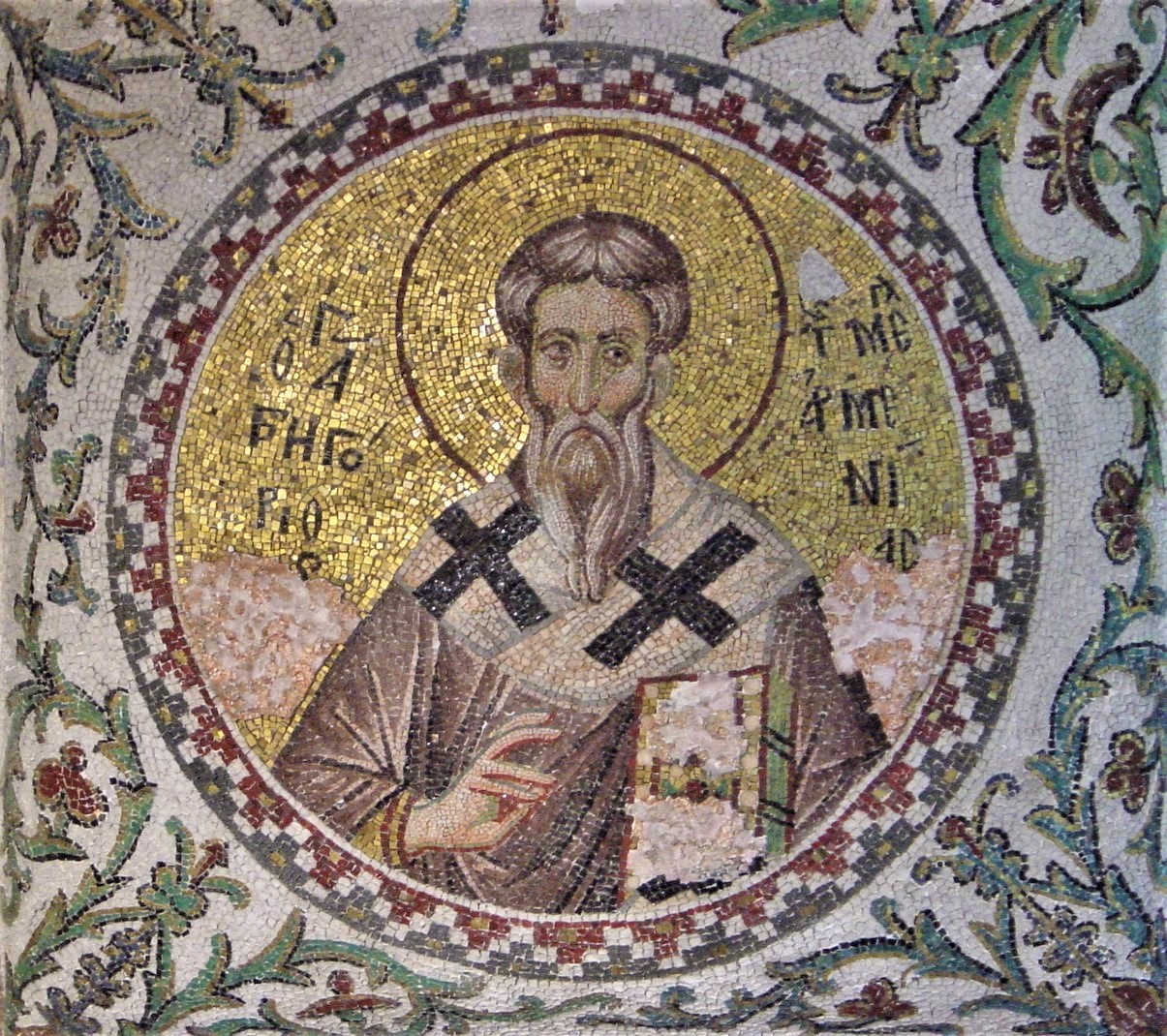
Look up the word illuminate in the dictionary, and you will find a variety of definitions, including “to make clear”, “to bring to the fore”, and "to enlighten spiritually or intellectually.” All of these definitions can be easily applied to the life of St. Gregory, who was given the additional title “the Illuminator” likely to differentiate him from the other St. Gregorys in the world. The person now known as Gregory the Illuminator (or in some cases Gregory the Enlightener) was born with the first name Suren in about 257 CE in Armenia to a Parthian nobleman. He was raised in Caesarea of Cappadocia as a Christian and did not return to Armenia until adulthood.
Once returned, he entered the service of King Tiridates III, who was intolerant of Christianity. King Tiridates asked Gregory to perform a pagan sacrifice, which he refused because of his Christian faith. This made the king angry, so the king ordered Gregory to be tortured and thrown into a pit filled with venomous snakes. The king’s sister was instrumental in Gregory's release from the pit 14 years later. Upon surviving his experience in the pit, Gregory converted King Tiridates to Christianity, and then Christianity was adopted as the state religion of Armenia in 301 CE. Gregory preached the Christian faith across Armenia and even healed (and later baptized!) King Tiridates, who, sources say, “had been driven into animal madness for his sinful behavior.” Quite a turn of events in the relationship between those two!
As a bishop, Gregory raised churches in place of destroyed pagan temples, founded schools, and established the ecclesiastical structure in Armenia, thus cementing Gregory’s status as a seminal figure in Armenian Christianity. Gregory’s two sons eventually succeeded Gregory as bishop. After Gregory’s retirement as bishop, he embraced a hermit lifestyle and lived out the remainder of his years in a cave, where he died around 328 CE. Gregory is such an instrumental figure in Armenian Christianity that he has three feast days dedicated to him: one commemorating the discovery of his relics, one commemorating the date of his descent into the snake pit, and yet another commemorating his release from said snake pit. In addition to the Armenian church, he is recognized with feast days in other Orthodox traditions and in the Anglican Communion. He is the patron saint of Armenia. Not surprisingly, there are many churches throughout the world named for St. Gregory the Illuminator, including a cathedral located less than 5 miles from where this biography is being written. Perhaps a selfie by this Celebrity Blogger in front of said cathedral will appear in future rounds if given the opportunity!
— Kathryn Nishibayashi
Collect for Gregory the Illuminator
Almighty God, who raised up your servant Gregory to be a light in the world, and to preach the Gospel to the people of Armenia: Illuminate our hearts, that we also in our own generation may show forth your praise, who called us out of darkness and into your marvelous light; through Jesus Christ our Lord, who lives and reigns with you and the Holy Spirit, one God, now and for ever. Amen.
Nino of Georgia
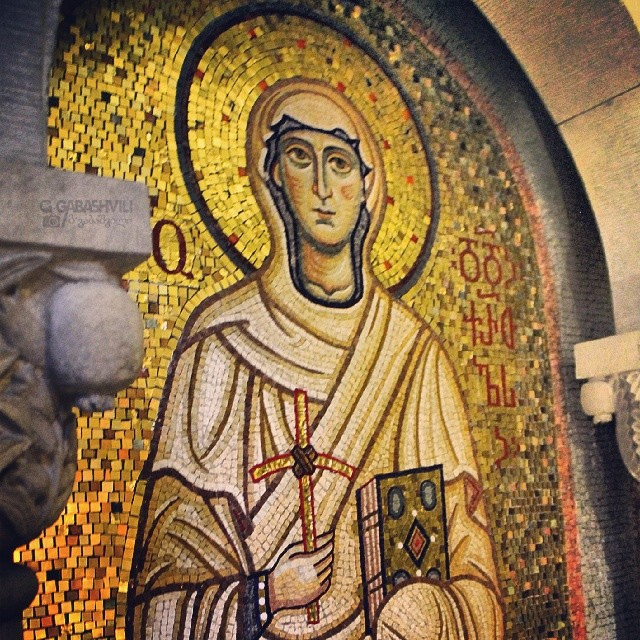
Just before the turn of the 4th century, a young girl was born to a Greek-speaking Roman family in Cappadocia. The baby, Nino, would go on to receive the title “Equal to the Apostles” from the Orthodox Church for her role as the “Enlightener of Georgia”—the woman who converted an entire country.
Nino had prominent parents in Roman society and so was raised by a nun in Jerusalem, immersed in the rhythms of early Roman Christianity. Perhaps because she showed promise as a future religious herself, the Patriarch of Jerusalem, who was also her uncle, helped her make her way to Rome. There she met and served the lady Hripsime, who had caught the eye of the Emperor Diocletian, a notoriously anti-Christian figure. To avoid his pursuit, with the help of Nino, Hripsime and her companions fled to Armenia. Along the way, Nino baptized the whole crew of women. These “35 virgins” went on to preach the word of God throughout Armenia.
They did not escape the notice of nobility in their new location, however, and soon King Tiridates III called for their beheading. Hripsime was martyred, but Nino made her way out and over to the Kingdom of Iberia, the modern-day country of Georgia.
There, she had her famous vision: Mary the Godbearer extending a cross of grapevines, with the instruction that Mary would be her shield in the work of converting the people there to the saving faith in Jesus. Nino received the grapevine cross and tied it with her own hair. Today, the “grapevine cross” is distinct for its drooping arms.
Nino traveled all over the Kingdom of Iberia converting people to Christianity. Eventually, she encountered Queen Nana, who had long suffered from debilitating illness. Nino healed her and baptized her. Her husband, King Mirian, initially rejected his wife’s conversion until his own miracle occurred. After being struck blind on an excursion, he prayed to the God of his wife and begged for healing. With his sight restored, he, too, was baptized and became the first Christian King of Iberia, securing the role of Christianity in the kingdom. Nino, seeing that she had fulfilled the instructions from her vision, retreated to the mountains, where she spent her remaining days living a monastic life.
Today, Nino is a Georgian national hero, whose faith laid the groundwork for the Georgian Orthodox Church. The name Nino is still to this day the most popular name for women in the country.
— Julia Offinger
Collect for Nino of Georgia
Almighty God, who called your servant Nino to be your apostle to the people of Georgia, to bring those wandering in darkness to the true light and knowledge of you; Grant us so to walk in that light, that we may come at last to the light of your everlasting day; through Jesus Christ our Lord, who lives and reigns with you and the Holy Spirit, one God, now and for ever. Amen.
56 comments on “Gregory the Illuminator vs. Nino of Georgia”
I keep having trouble voting!!!
Try a different device.
Just seems as though Gregory did more.
I appreciate that King Tiridates is a villain in both accounts -- just saw him as portrayed in Handel's opera Radamisto where he's equally out of control but gets magically converted to good government in the final scene (would that we could see some of that here).
I was already leaning towards Nino as a woman evangelist and leader, but then read St Cecilia's post about the girls in Iran killed by US-Israeli bombing of their elementary school. I am seeing reports of up to 160/170 deaths. So now I'm voting for Nino, as a woman who survived and led and spread the Gospel, along with her other women companions who were martyred.
My vote went to Nino. I was intrigued by her vision of Mary gifting her with a grapevine cross for protection as she went about her work. I'd like to hear more about that aspect of Nino's story.
I found this little book about her:
https://a.co/d/03K6SAgW
"Why must there always be snakes?"
Vote for Gregory or my family will make me legally change my name!
Why does the Monday Madness score shown for Amy Carmichael versus Edith Stein show a much closer vote than the end result shown in the "recent post" here on this site??????
Let’s go Ladies!! A new Saints from the country of Georgia
Having read the bio of Gregory in the Catholic publication (https://www.newadvent.org/cathen/07023a.htm), there was a lot more in the pit than snakes. There was also a lot more to the man. I realize space limits how much can be told, but I think the write-ups should reflect more than the sketches we have been provided.
I also read the account of the Orthodox Church on Nino (https://www.oca.org/saints/lives/2013/01/14/100191-saint-nino-nina-equal-of-the-apostles-enlightener-of-georgia). As a long-time intercessor, the one thing I am sure of is that I heal no one. The account from the Orthodox Church would indicate Nino did not heal anyone either. She prayed and healings occurred. Even one healing came after the king prayed to her Christian God as a last resort.
I know a lot of what we hear and read about the various saints from the early church is based more on tradition and stories than actual facts, but at least the saints should be represented as accurately as possible. Leave the traditions and stories to the second round.
Gregory hands down! Suffering in a poisonous snake pit for 14 years and then healing and baptizing the King that tried to off him, now that's strength of character if I ever saw it, what an inspiration! Then to go on to found churches and schools then go live alone in a cave til the end in humility, an exemplary life!
I voted for St Nino, but I might've also selected her in my bracket if I'd realized she's also called St Nina. I'm on the mailing list for a monastery of Orthodox nuns originally dedicated to St Nina, and now for St Sidonia.
One of the items I bought from their website some years ago was a CD of Georgian chant, which I'd never heard before. It's lovely.
Just like for Daniel in the lion's den and his three friends in the fire pit, God must have been with Gregory in the snake pit. So he gets my vote.
Gregory hands down! Suffering in a poisonous snake pit for 14 years! If that wasn't enough then he healed and baptized the King who put him there showed strength of character, perseverance, long-suffering and true heart. Inspiring! Then to go on and start churches and schools only to retire humbly alone in a cave, what an example!
You didn't indicate who won the contest on Friday, February 27.
My email arrived at 11:32 Monday nite, and I’m glad I didn’t miss a vote since I may be among the few here who DO know of Nino/Nina.
She was often known simply as “The Christian,” and I was taught for 12 years (in Salem, MA) by an order of French nuns, the Sisters of Ste Chrétienne. Nina the Christian, the Apostle to Georgia, is their patron saint.
I have a phobic fear of snakes, so this was an easy vote!
Receiving the lent madness emails a day late makes me feel like I'm disenfranchised!