The Battle of Nations founders DELIVERED 🇬🇪🔥 St. Nino has officially put Georgia on the map (and in our brackets) with a strong win over Gregory the Illuminator 63.91% to 36.09% 💪
But don’t get comfortable… we’re heading into the Modern Mercifuls and things are getting REAL. Welcome to the war for Westminster Abbey’s door 🏰 where both these saints are immortalized as two giants of 20th-century faith, courage, and witness.
Janani Luwum vs Wang Zhiming! Martyr vs martyr. Courage vs courage. No easy picks here. Only one moves on. Only one gets closer to the Golden Halo ✨ Watch the video, read the blogs, and VOTE!
Janani Luwum
Born in 1922 in the village of Mucwini in Uganda’s Acholi region, Janani Jakaliya Luwum grew up herding livestock on the family farm. Money was scarce, delaying his start in school until age ten. He attended a primary school in Gulu, studied to become a teacher in secondary school, and eventually returned to teach at his primary school.
In 1947, Luwum married his wife Mary and, over the years, had many children together. It was not until Luwum was about 26 years old (1948) that he became a Christian during the East African Revival. Reminiscing years later he described the moment he came to believe in Christ, “I was overwhelmed by a sense of joy and peace…The reality of Jesus overwhelmed me – and it still does.” He started to evangelize fellow teachers, students, and villagers—anyone who would listen to him.
Within the year of his conversion, his gift for evangelizing to anyone and everyone shifted what he envisioned for his life into working in fulltime ministry. However, his original goal of political aspirations never left him. For Luwum, his faith and first dream of politics worked hand in hand—they were not two interests to be separated. The combination of these two purposes led to him working tirelessly and fiercely against corruption. This relentlessness for his cause is what led to his martyrdom.
In 1954, he became an Anglican deacon and two years later rose to being an Anglican priest. In 1969, he became an ordained bishop of Northern Uganda. He started gaining national attention for his immense care of his flock. Like many biblical figures, he had practiced shepherding early on in his childhood. He garnered international attention due to his zest for proclaiming the gospel to allies and persecutors alike. In 1974, Luwum’s notoriety led to him being elected archbishop of the Ugandan church, continuing to lead and be an example to more people.
Uganda continued to be ruled by dictators like Idi Amin, who Luwum and other supporters of justice continuously confronted. Luwum suspected his time was limited after his last negotiation with Amin. Two months before his murder he shared with the public, “I do not know for how long I shall be occupying this chair. I live as though there will be no tomorrow.” On February 16, 1977, Luwum was slaughtered by Amin and his regime. Luwum was shot twice in the chest and once in the mouth. Amin and his goons ran over Luwum’s body trying to disguise it as a car accident. His martyrdom inspired a revival in Uganda and around the world.
— Sara Kay Hill
Collect for Janani Luwum
O God, whose Son the Good Shepherd laid down his life for his sheep: We give you thanks for your faithful shepherd, Janani Luwum, who after his Savior’s example gave up his life for the sake of his flock. Grant us to be so inspired by his witness that we make no peace with oppression, but live as those who are sealed with the cross of Christ, who died and rose again, and now lives and reigns with you and the Holy Spirit, one God, for ever and ever. Amen.
Wang Zhiming
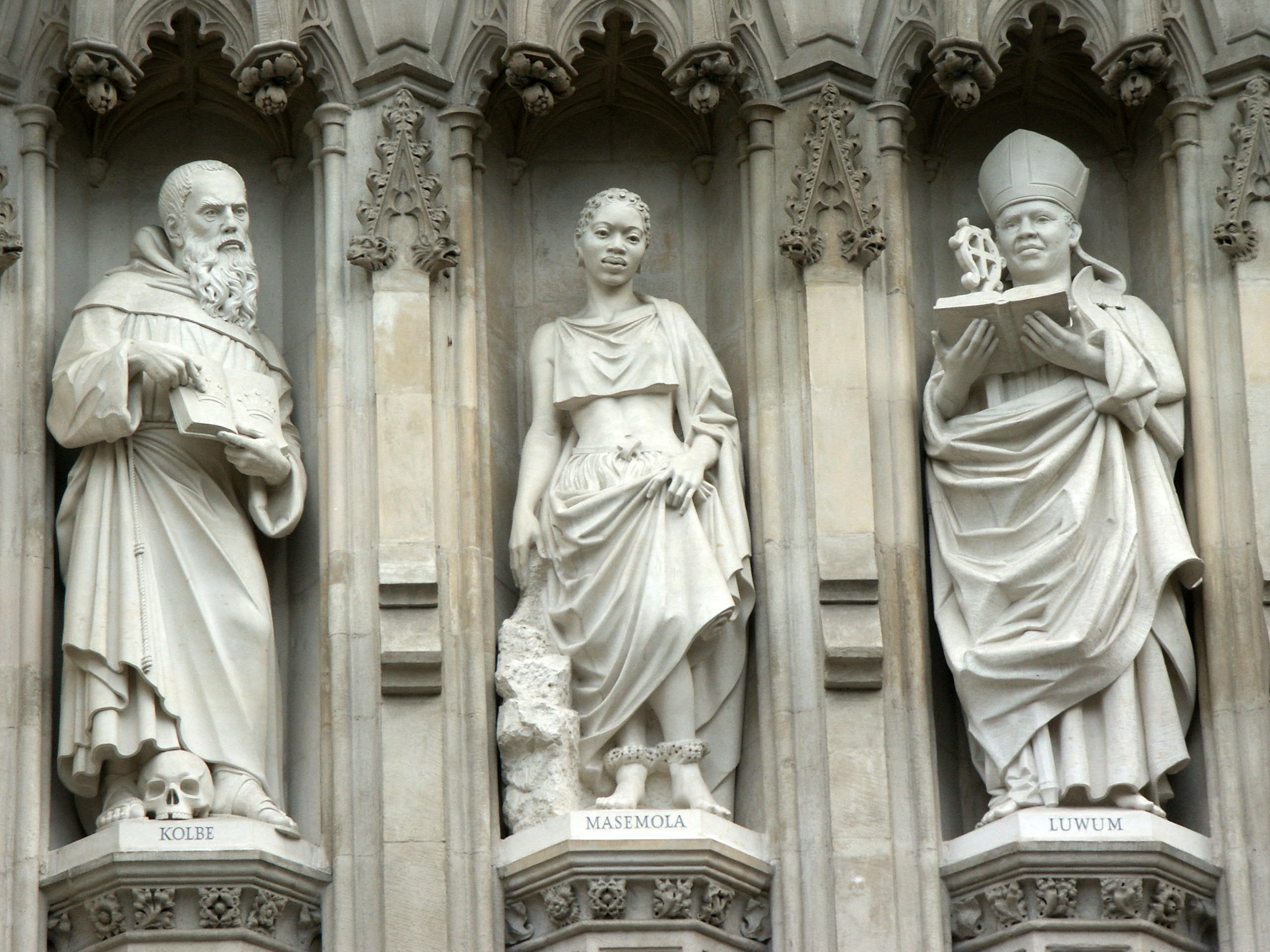
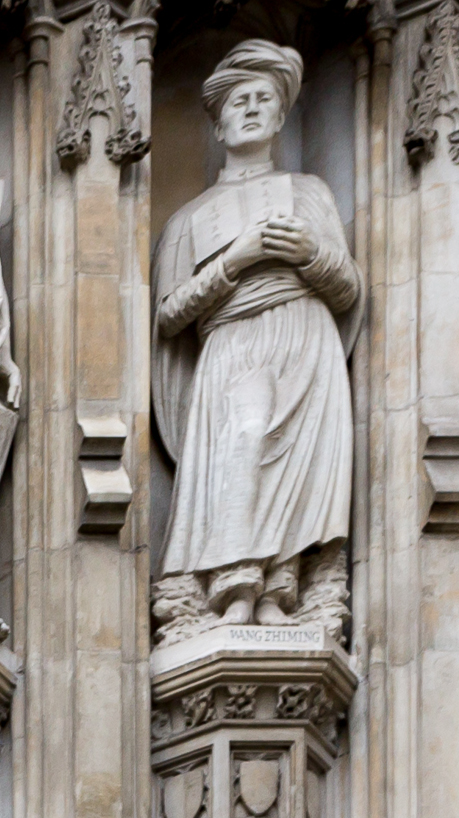
Above the great West door of Westminster Abbey stand ten statues, carefully selected to represent the great martyrs of the 20th century. One has already worn the coveted Golden Halo of Lent Madness: Dietrich Bonhoeffer. Others are names known to many: Archbishop Oscar Romero, The Reverend Doctor Martin Luther King, Jr, and Grand Duchess Elizabeth of Russia. Standing among them is a man whose story you probably don’t know, but should: Wang Zhiming.
Wang Zhiming was born in Wuding, China in 1907. Christianity came to the Miao people of China (known as the Hmong in other parts of Southeast Asia) around 1798 via Catholic missionaries. In the early 1900s, Protestant missionaries Arthur Nicholls, Samuel Pollard, and others translated the Bible into the Miao language, taught the basics of the faith, and implemented social reforms in medicine, education, and infrastructure. One outcome of their work was the establishment of several Christian schools in the area.
As a child, Wang Zhiming was educated at a Christian school established by those Protestant missionaries; as a result, he became a Christian. After graduation, Wang taught at Christian schools for ten years and began his ministry as a lay preacher, later serving as president of the area’s general assembly and overseeing the Miao churches in Wuding, Luquan, Fumin, Lufeng, and Yuanmou counties.
In 1945, still as a lay leader in his church, Wang traveled to Kunming to help translate and assemble the Miao version of Hymns of Praise to the Lord, which may have been the first Miao hymnbook in China.
Wang was ordained a pastor around 1952. As both a lay leader and a pastor, Wang cared for and encouraged the people in his care, helping nourish faith and hope among a particularly impoverished community.
During the Cultural Revolution, the area where Wang lived in Wuding became a particular target of the regime’s violent attacks on religion. As an example, Wang was declared a counterrevolutionary; one of the charges against him was that he engaged in “religious espionage” by disseminating a spiritual opium (religion) that dulled the masses. He was one of the twenty-one Christian leaders who were imprisoned in Wuding between 1969 and 1973. During his detention, Wang was tortured mentally and physically. Repeatedly asked, “Do you trust Mao Zedong or Jesus?” his unwavering response was “I believe in Jesus.”
On December 28, 1973, Wang was sentenced to death at the age of 66. His trial was held on a middle school playground and attended by approximately 10,000 people. Reports say that in the moments before his execution, he faced the congregation “with a smile on his face, showing not fear but joy.” (Christianity Today article)
Wang Zhiming was an ordinary Christian—raised up as a lay leader in his church, serving for many years before ordination, and offering his gifts to the leadership of his people. Yet his witness and example are extraordinary indeed—a modern martyr who shows us all what it means to stand up to the powers of an unjust government and refuse to renounce one’s faith. Wang Zhiming is a name you should know, and a saint you should vote for!
— Forward Movement staff
Collect for Wang Zhiming
Almighty God, who gave to your servant Wang Zhiming boldness to confess the Name of our Savior Jesus Christ before the rulers of this world, and courage to die for this faith: Grant that we may always be ready to give a reason for the hope that is in us, and to suffer gladly for the sake of our Lord Jesus Christ; who lives and reigns with you and the Holy Spirit, one God, for ever and ever. Amen.
Both lead their people against government oppression. Having witnessed the spirit of the Hmong congregations they established in our area, and heard stories of escape from children in our school, I voted for Wang in honor of their ethnic sacrifice for God and liberty.
5
I just voted for the one who has fewer votes. There is no loser here. I am certain that they both finished first in the end!
The Hmong people suffered terribly under several regimes, China especially and many became immigrants to the U.S. after Vietnam. Their culture is colorful and beautiful and still survives. In admiration, I vote for Wang.
5
Forgive me for voting for personal reasons today between these two worthy martyrs. I served in neighboring Kenya right before starting seminary, and have been blessed with dear colleagues and friends who lived and served in Uganda teaching, healing, and rebuilding in the aftermath of Idi Amin's regime. I am heartbroken that amid Uganda's troubled history, hateful distortions of the Good News have overtaken and divided Anglicanism there. God weeps, yet again.
7
Another impossible choice. And in all truth, SEC, I appreciate how you've set things up this year because I've had to ponder deeply right from the start. As always, part of that is reading others' comments, which are part of the whole richness of Lent Madness for me.
Both of today's choices are so compelling and worthy. And I'd love a tie, as others have suggested. Nevertheless, I'm voting for Junani Luwum, who'se about 450 votes ahead right now (so tempted to vote for Wang Zhiming to even the score).
The collect "to make no peace with oppression," Luwum's ongoing fight against corruption, and the Amin regimes lies about his murder . . . all feel important to where we are today.
The Cultural Revolution was also a brutal time -- so all honor and gratitude to Wang Zhiming also for his courageous witness.
9
This vote was impossible! I eventually decided on Zhiming because of his Miao translation of hymns, making them accessible to more people (who could read them in secret). But I would have voted for Zuwum as well if I could. Someone else suggested the ones who do not make the bracket this year be returned automatically for next year's Lent Madness and I second that suggestion.
3
This is like asking which brother do I give up!
I like that she became a pastor and wanted to her whole life
0
Both men deserve the attention and respect due a true martyr.
1
And Africa tipped the balance for me. My uncle Joseph Parsell served in Liberia with the Order of the Holy Cross for almost 40 years.
1
Even though I find the life of Janani Luwum fascinating — a man who came from a very modest background and rose to become a bishop of the Anglican Church — I have to vote for Wang Zhiming, given that I was born in Cuba and experienced firsthand a Communist totalitarian regime. In addition, Wang Zhiming was executed in the year I was born.
A classmate at my seminary was a former aide to Janani Luwum, about whom he could never speak without profound emotion. He later became Bishop of Gulu, and during his tenure his wife was killed by a landmine. Seeing Archbishop Luwum's name in the slate brought back many powerful memories.
It is a timely look at two martyrs who stood faithful in the face of dictatorship. Luwum’s collect influenced me. I also recently returned from Rwanda where I saw the result of pitting one group against another group at the Genocide memorial. My vote goes to Luwum.
This was probably my most difficult choice so far.
An almost impossible choice. But went with Wang because …. he chose Jesus.
I couldn’t decide between the two until I read that Wang Zhiming worked on the hymnal, and that did it for me.
4
Is Janani Luwum the patron saint of cats?
"I sometimes wonder what Janini Luwum would think of the split in the Anglican Communion under GAFCON, spearheaded by the former Archbishops of Nigeria and Uganda." Renee, this is my question too. I was just listening this morning to NPR's account of GAFCON's current meeting to elect an alternate leader to the Archbishop-of-Canterbury-elect Sarah Mullally. This divisive act surely does not reflect the legacy of Janini Luwum, who is certainly worthy of the Golden Halo! But so is Wang Zhiming, and so I am voting for him. He's a natural choice for me, as my PhD dissertation was on the 19th C missions to China and Japan.
3
Well, it looks like Janani Luwum is going to win this one, but I voted for Wang Zhiming in honor of my maternal grandfather, who served as a missionary in the Wuhan area of China in the 1940s and had to flee with my grandmother and their two young children (my aunt & uncle) when the Communists came to power.
1
Just like Wang better.
This was not the easiest to decide. However, I remember what happened in Africa to Luwun. We had an African paster visit our church last Fall and he spoke of Luwun's example of a Christian life in a place it wasn't exactly wanted and how it inspired this Lutheran pastor.
I can't choose.
This was a very difficult decision. I chose Wang because I like the Chinese Culture. Both countries and their people suffered under the regimes of Zedong & Amin.
0
This one was hard!
"In 1974, Luwum’s notoriety led to him being elected archbishop of the Ugandan church, continuing to lead and be an example to more people."? I don't see any evidence that Luwum was notorious.
Still can't vote as emails arrive a day late.
Today is March 4 and I just received the March 3 contest.
Both stories of these beautiful saints have put joy in my heart . To know that they lived not so long ago and faced brutal oppression and did not overcome them but still their faith and life endured.
64 comments on “Janani Luwum vs. Wang Zhiming”
Both lead their people against government oppression. Having witnessed the spirit of the Hmong congregations they established in our area, and heard stories of escape from children in our school, I voted for Wang in honor of their ethnic sacrifice for God and liberty.
I just voted for the one who has fewer votes. There is no loser here. I am certain that they both finished first in the end!
The Hmong people suffered terribly under several regimes, China especially and many became immigrants to the U.S. after Vietnam. Their culture is colorful and beautiful and still survives. In admiration, I vote for Wang.
Forgive me for voting for personal reasons today between these two worthy martyrs. I served in neighboring Kenya right before starting seminary, and have been blessed with dear colleagues and friends who lived and served in Uganda teaching, healing, and rebuilding in the aftermath of Idi Amin's regime. I am heartbroken that amid Uganda's troubled history, hateful distortions of the Good News have overtaken and divided Anglicanism there. God weeps, yet again.
Another impossible choice. And in all truth, SEC, I appreciate how you've set things up this year because I've had to ponder deeply right from the start. As always, part of that is reading others' comments, which are part of the whole richness of Lent Madness for me.
Both of today's choices are so compelling and worthy. And I'd love a tie, as others have suggested. Nevertheless, I'm voting for Junani Luwum, who'se about 450 votes ahead right now (so tempted to vote for Wang Zhiming to even the score).
The collect "to make no peace with oppression," Luwum's ongoing fight against corruption, and the Amin regimes lies about his murder . . . all feel important to where we are today.
The Cultural Revolution was also a brutal time -- so all honor and gratitude to Wang Zhiming also for his courageous witness.
This vote was impossible! I eventually decided on Zhiming because of his Miao translation of hymns, making them accessible to more people (who could read them in secret). But I would have voted for Zuwum as well if I could. Someone else suggested the ones who do not make the bracket this year be returned automatically for next year's Lent Madness and I second that suggestion.
This is like asking which brother do I give up!
I like that she became a pastor and wanted to her whole life
Both men deserve the attention and respect due a true martyr.
And Africa tipped the balance for me. My uncle Joseph Parsell served in Liberia with the Order of the Holy Cross for almost 40 years.
Even though I find the life of Janani Luwum fascinating — a man who came from a very modest background and rose to become a bishop of the Anglican Church — I have to vote for Wang Zhiming, given that I was born in Cuba and experienced firsthand a Communist totalitarian regime. In addition, Wang Zhiming was executed in the year I was born.
A classmate at my seminary was a former aide to Janani Luwum, about whom he could never speak without profound emotion. He later became Bishop of Gulu, and during his tenure his wife was killed by a landmine. Seeing Archbishop Luwum's name in the slate brought back many powerful memories.
It is a timely look at two martyrs who stood faithful in the face of dictatorship. Luwum’s collect influenced me. I also recently returned from Rwanda where I saw the result of pitting one group against another group at the Genocide memorial. My vote goes to Luwum.
This was probably my most difficult choice so far.
An almost impossible choice. But went with Wang because …. he chose Jesus.
I couldn’t decide between the two until I read that Wang Zhiming worked on the hymnal, and that did it for me.
Is Janani Luwum the patron saint of cats?
"I sometimes wonder what Janini Luwum would think of the split in the Anglican Communion under GAFCON, spearheaded by the former Archbishops of Nigeria and Uganda." Renee, this is my question too. I was just listening this morning to NPR's account of GAFCON's current meeting to elect an alternate leader to the Archbishop-of-Canterbury-elect Sarah Mullally. This divisive act surely does not reflect the legacy of Janini Luwum, who is certainly worthy of the Golden Halo! But so is Wang Zhiming, and so I am voting for him. He's a natural choice for me, as my PhD dissertation was on the 19th C missions to China and Japan.
Well, it looks like Janani Luwum is going to win this one, but I voted for Wang Zhiming in honor of my maternal grandfather, who served as a missionary in the Wuhan area of China in the 1940s and had to flee with my grandmother and their two young children (my aunt & uncle) when the Communists came to power.
Just like Wang better.
This was not the easiest to decide. However, I remember what happened in Africa to Luwun. We had an African paster visit our church last Fall and he spoke of Luwun's example of a Christian life in a place it wasn't exactly wanted and how it inspired this Lutheran pastor.
I can't choose.
This was a very difficult decision. I chose Wang because I like the Chinese Culture. Both countries and their people suffered under the regimes of Zedong & Amin.
This one was hard!
"In 1974, Luwum’s notoriety led to him being elected archbishop of the Ugandan church, continuing to lead and be an example to more people."? I don't see any evidence that Luwum was notorious.
Still can't vote as emails arrive a day late.
Today is March 4 and I just received the March 3 contest.
Both stories of these beautiful saints have put joy in my heart . To know that they lived not so long ago and faced brutal oppression and did not overcome them but still their faith and life endured.