In yesterday's battle of the apostles, Peter triumphed over Paul 65% to 35%! For our next match we return to the DenomiNATION Domination section of the bracket with two Anglican ancestors. Read on and cast your vote!
Richard Hooker
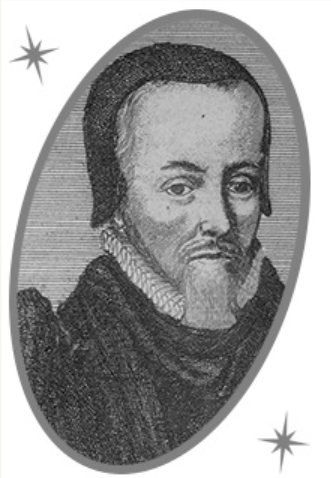
Richard Hooker is considered the "Father of Anglican Theology." He was highly educated, a priest, a theologian, a scholar, a philosopher, and a leader in the Protestant Revolution. And we have Hooker to thank for the familiar metaphor of the three-legged stool!
He was born in England in 1554, the year Mary was crowned queen and reestablished Roman Catholicism in Protestant England, and just a few years shy of the dawn of the Elizabethan era. Hooker boasted an impressive formal education and graduated from Oxford. For good reason, Hooker is considered one of the most important theologians of the 16th century.
The year 1581 was pivotal in many ways: Queen Elizabeth 1 was now on the throne; Parliament approved strict anti-Catholic laws; Hooker was ordained a priest and was married.
Though serving flocks throughout the English countryside, he was far more than a country parson. Hooker’s mastery of various skills would come in handy. In addition to his deep thinking, he had a command of the English language and an astute understanding of the law.
As a priest, he served churches in Salisbury, near Canterbury, and outside London. That changed in 1586 when Queen Elizabeth named him Master, or senior cleric, of the Temple Church in London, a prestigious posting.
While in London, Hooker’s preaching angered the uptight Puritans, who claimed he strayed from the beliefs and practices of predestination. In true form, his response was measured and methodical. It was at this point that Hooker began writing the seminal document “The Laws of Ecclesiastical Polity,” a comprehensive defense of the Reformation.
In this treatise, he argued that all belief is grounded in Scripture, tradition, and reason - hence that three-legged stool! Among the key points he made – and there were many! – were the defense of the Book of Common Prayer and counterstrikes against attacks by the Puritans. He forged the Anglican via media between Protestantism and Catholicism.
“The Laws of Ecclesiastical Polity” consisted of eight books printed over five years, some published posthumously.
After London, Hooker returned to parish life in Salisbury, where he served as the subdean of the Cathedral, and then later in Kent. He died at Bishopsbourne on November 3, 1600, survived by his wife and four daughters. His commemoration is on November 3.
— Neva Rae Fox
Collect for Richard Hooker
O God of truth and peace, you raised up your servant Richard Hooker in a day of bitter controversy to defend with sound reasoning and great charity the catholic and reformed religion: Grant that we may maintain that middle way, not as a compromise for the sake of peace, but as a comprehension for the sake of truth; through Jesus Christ our Lord, who lives and reigns with you and the Holy Spirit, one God, for ever and ever. Amen.
Thomas Cranmer
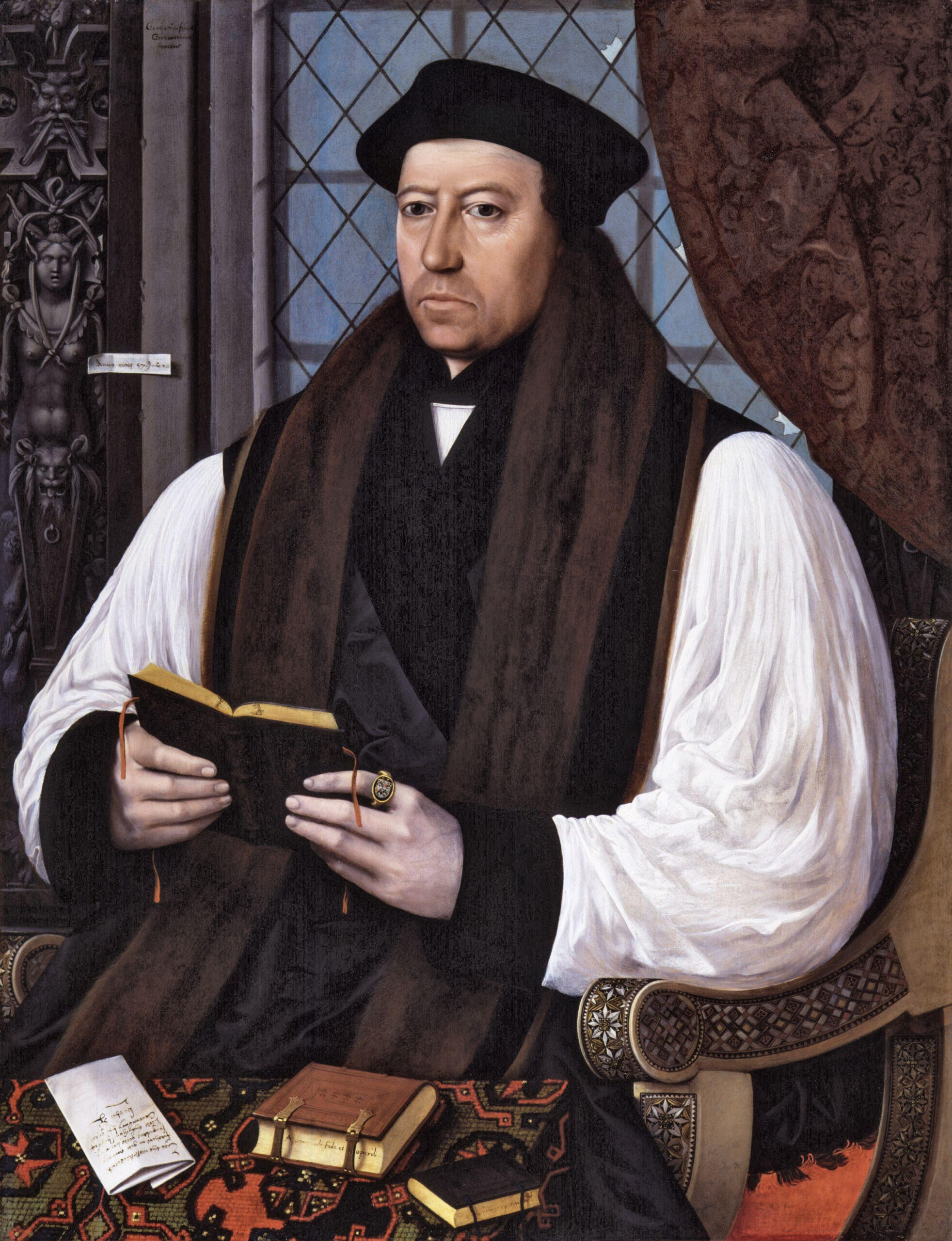
Tommy, Tommy, Tommy. What is there to say? A whole lot, but I’m not sure you haven’t heard it before. When one reads about the life of Thomas Cranmer, it’s hard to not see the way in which relationships were key to how he moved through the world, and maybe harder to divorce his legacy from that of King Henry VIII —a lot harder than it was for Henry to divorce all of his wives.
In 1532, while on the road in Italy, Cranmer received notice that he now occupied the seat of Archbishop of Canterbury, thanks to the woman being courted by Henry, Anne Boleyn. Soon, Cranmer, as Archbishop, would be annulling Catherine’s marriage, excommunicating Catherine, blessing Anne and Henry’s marriage, baptizing their first child, and within three years giving Anne last rites before she was executed for her, it seems, inability to bear a son. Cranmer publicly mourned her death and begged the King not to divorce her. Bless.
By 1543, Cranmer’s quiet leanings toward reform of the Catholic Church and public support and closeness to Henry had provided protection in anti-reform movements, so he began to turn to reforming not just the theology, but the liturgy. On May 27, 1544, we get the great-great-grandfather to our BCP: Exhortation and Litany, a liturgy in English. Eventually there was the need for a more Common Book of Prayer, and in 1549, the first version of BCP was used in worship. By 1552, Cranmer was leading the charge of reform of the Church in England with the Forty-two Articles. It is clear that the pre-teen king didn’t occupy quite as much of his time as his father did.
After Edward’s death in 1553, his sister Mary, a devout Catholic and anti-reformer, took the throne. Within six months, Cranmer was charged with high treason and condemned to death. Cranmer was imprisoned for nearly two years before he recanted all of his writings and works, but it was not enough though this should have saved his life, he was burned at the stake on March 21, 1556. He was killed, but not before he renounced his recantations from the pulpit at the Oxford University Church pulpit. As record has it, as the flames surrounded him, he placed his right hand into the middle of the fire, as it was “the unworthy hand” that wrote the renunciations.
Cranmer’s legacy remains, and there’s much to cover in little time. I didn’t even get to tell you about his not-secret/secret wife at the end of his life that denied his priestly call to celibacy, but that’s for next time.
— Becca Kello
Collect for Thomas Cranmer
Keep us, O Lord, constant in faith and zealous in witness, that, like your servants Hugh Latimer, Nicholas Ridley, and Thomas Cranmer we may live in your fear, die in your favor, and rest in your peace; for the sake of Jesus Christ, your Son our Lord, who lives and reigns with you and the Holy Spirit, one God, now and for ever. Amen.
84 comments on “Richard Hooker vs. Thomas Cranmer”
Cranmer’s prayer book gives Anglicanism its soul, but Hookers via media, three legged stool, and theology gives it identity. Cranmer’s work still binds us, but has been revised and transformed in the light of Hooker’s work. Tough matchup, but this Anglican is siding with Hooker
Big Richard Hooker fan here! I set myself to read Church Polity once and surprised myself by being moved to tears reading his analysis of Communion.
Remember, as you read, that without modern media people really valued lengthy explanations as a form of entertainment, and the Polity will be less daunting.
Hopefully Richard Hooker moves on as I now want to learn more of his work, and the historical and thelogical foundation he seems to have left us with.
Cranmer for his martyrdom
Richard Hooker defended our lovely Book of Common Prayer. That's enough to get my vote. The facts that he opposed the idea of foreordination and wasn't afraid to annoy the Puritans are nice extra.
Grrr... this is SO hard! The creator of the Church of England against the theologian who gave the Church of England it's special identity!
Why couldn't these guys been run up against Bob the Peasant, a forest father who lived a hermit's life but left no writings!
Love your response!
I'm sure there would be some votes for Bob the Peasant, though. "Well, Cranmer did give us the BCP and end up dying for his beliefs, but there's just something about this apocryphal, forest-dwelling recluse who communicated only by grunts, ate raw badger, and terrorized the countryside that speaks to me, even if he didn't."
You've convinced me. Badger-eatin' Bob ftw!
Cranmer lived during what, in many ways, were dark and dangerous times, requiring a public and political stand that in the end required his life for his faith. A long and winding road that has resonance today, and that challenges us to consider our choices, our witness, and what sacrifice we might, in the end, be willing to make. And: the solace, power and beauty of the BCP. I love Anglican theology, but in need, in joy, in prayer: the collects, and the liturgy.
Strange fact. I became an Anglican after reading part of The Laws of Ecclesiastical Polity. So my vote goes to Hooker.
This was such a difficult one to decide, but in the end it was the via media which won over the BCP. Or maybe it is that we seem to spend far too much time separating Anglicanism’s beginning from Henry VIII rather than embracing the beauty of our liturgy and the clarity of our theology.
This was a tough choice. I generally go with the scholars, but I read a bit of Cranmer and was so impressed by his generosity of spirit. So different than the usual "this is the one and only truth" that most of the scholars leave behind.
I was going to go with Cranmer before I read either of the writings because of similarities with Peter ( denial/recanting to rock of the church/recantingof recanting and martyrdom), but after reading the post on Hooker, I had to choose him,
Today, I proved I was not a robot, but was not allowed to vote. Frustrating. Nice to read the histories, though.
I sometimes have trouble voting on my iPad but can usually do it on the iPhone.
This is the first day I've had to prove that I am not a robot. I'm not sure what I've done to create doubt.
Anothertough day at the polls! I love both these guys for what the gave us. At the end of each day, we Episcopalians have one thing that brings us back together, which no other protestant denomination has: The Book of Common Prayer. I love this book, and for that I can thank Cranmer. However, it is the thre-legged stool and via media that makes me proudest of my church. Thank you, Rev. Hooked! Jeesh, I really hope the decisions in the mid-terms aren't as hard as this first week of Lent Madness! LOL!
Another tough day at the polls! I love both these guys for what the gave us. At the end of each day, we Episcopalians have one thing that brings us back together, which no other protestant denomination has: The Book of Common Prayer. I love this book, and for that I can thank Cranmer. However, it is the thre-legged stool and via media that makes me proudest of my church. Thank you, Rev. Hooked! Jeesh, I really hope the decisions in the mid-terms aren't as hard as this first week of Lent Madness! LOL!
Neva Fox' bio was extremely well-written. I look forward to her future efforts.
I agree. Mega Fox always does a marvelous job of writing. One of the best.
Yes, we appreciate the BCP, but Cramner was quite flaky. Thank goodness for Richard Hooker and his theology! Also to Neva Rae Fox excellent summary of his life.
Gotta go with the three legged stool. Still used today in adult formation.
We Methodists have added a fourth leg, experience, to create our Quadrilateral. I'm not sure that experience carries the same weight as Hooker's three.
Yet another impossible pairing -- the voice of our theology and identity vs. the heart of our liturgy and prayer!
I'm sitting on that 3-legged stool, my thoughts dancing with that dynamic and sometimes destabilizing 4th leg of experience, pondering: how do we even separate the two? Leonel Mitchell's fine book has an even more profound title: Praying Shapes Believing. Years before most of us might have even heard of Richard Hooker, our faith, prayer life, and spirituality were already being given form and wings by Thomas Cranmer's soaring and profound prayers, words, and metaphors.
My mind grows daily more appreciative of Hooker's theology and ecclesiology. But my heart sings and swoons and soars with Cranmer's sublime and wise poetry and prayers. I'm voting with my heart today.
Tommy Tommy Tommy? I’m voting for Cranmer if only in objection to that totally smarmy write-up. C’mon… have a little class.
Thank you, YES! I feel like Cranmer was done dirty with this bio. I think that the same person should write both bios for the first round of voting!
Again I can’t vote EXCEPT for the other choice. What’s going on. You’re ruining this program.
Richard Hooker's Collect is just about my favorite in the entire BCP..."maintain that middle way not as a compromise for the sake of peace, but as a comprehension for the sake of truth." Wish I'd said that!
My vote goes to Richard Hooker today!
For my favorite book and because I want to hear about his wife, I voted for the Archbishop.
This was such a hard decision. Richard Hooker has so much merit, and I LOVE the via media (as well as the three-legged stool metaphor). However, I think Thomas Cranmer is underrated. I love the Book of Common Prayer. Also, he gets a few extra points for dealing with Henry VIII. He died a martyr's death.
I thought the authors who wrote each saint's bio were supposed to be endorsing that saint. The bio on Cranmer has many negative comments.
I totally agree. The Archbishop got a very poor bio.
Another "1/2 vote to each" match-up ...
Vote to Hooker, who set forth not only the foundations of Anglican theology, but did it in the thoughtful, measured way we Anglicans do our business.
As for Cranmer: admiration for setting forth worship in the manner we have all come to appreciate and to love. As for his politics ... well, let us also consider with whom he had to work.
Two outstanding Anglicans. I voted for Cranmer because his heart was in the right place. Hooker maybe was the more learned however Cranmer gave us our great BCP.
But—but—the Prayer Book y’all! What would we do without the dear BCP??
There is profound beauty in Cranmer's words, but Hooker's three legged stool is the genius of Anglicanism. If only we were more attentive to it today, instead of elevating one leg above the others.
Cranmer is a tough one. The whole thing around his manipulation with the divorce etc is a turn off but,were it not for Henry’s marriage to Anne, we would not have had Elizabeth who was quite the queen and contributed to the evolution of the church.
Still. I went with Hooker. I’ve always loved that three legged stool thing that we do.
I’m going to say it, when the bios are not uniformly written, it can really influence the vote. That doesn’t seem fair.