In yesterday's battle of the apostles, Peter triumphed over Paul 65% to 35%! For our next match we return to the DenomiNATION Domination section of the bracket with two Anglican ancestors. Read on and cast your vote!
Richard Hooker
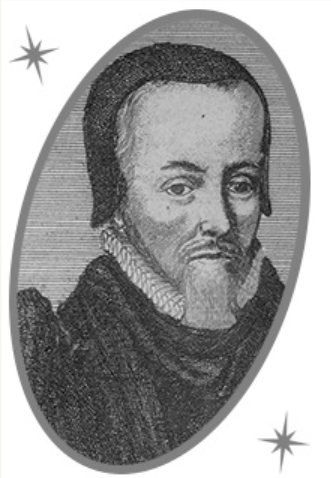
Richard Hooker is considered the "Father of Anglican Theology." He was highly educated, a priest, a theologian, a scholar, a philosopher, and a leader in the Protestant Revolution. And we have Hooker to thank for the familiar metaphor of the three-legged stool!
He was born in England in 1554, the year Mary was crowned queen and reestablished Roman Catholicism in Protestant England, and just a few years shy of the dawn of the Elizabethan era. Hooker boasted an impressive formal education and graduated from Oxford. For good reason, Hooker is considered one of the most important theologians of the 16th century.
The year 1581 was pivotal in many ways: Queen Elizabeth 1 was now on the throne; Parliament approved strict anti-Catholic laws; Hooker was ordained a priest and was married.
Though serving flocks throughout the English countryside, he was far more than a country parson. Hooker’s mastery of various skills would come in handy. In addition to his deep thinking, he had a command of the English language and an astute understanding of the law.
As a priest, he served churches in Salisbury, near Canterbury, and outside London. That changed in 1586 when Queen Elizabeth named him Master, or senior cleric, of the Temple Church in London, a prestigious posting.
While in London, Hooker’s preaching angered the uptight Puritans, who claimed he strayed from the beliefs and practices of predestination. In true form, his response was measured and methodical. It was at this point that Hooker began writing the seminal document “The Laws of Ecclesiastical Polity,” a comprehensive defense of the Reformation.
In this treatise, he argued that all belief is grounded in Scripture, tradition, and reason - hence that three-legged stool! Among the key points he made – and there were many! – were the defense of the Book of Common Prayer and counterstrikes against attacks by the Puritans. He forged the Anglican via media between Protestantism and Catholicism.
“The Laws of Ecclesiastical Polity” consisted of eight books printed over five years, some published posthumously.
After London, Hooker returned to parish life in Salisbury, where he served as the subdean of the Cathedral, and then later in Kent. He died at Bishopsbourne on November 3, 1600, survived by his wife and four daughters. His commemoration is on November 3.
— Neva Rae Fox
Collect for Richard Hooker
O God of truth and peace, you raised up your servant Richard Hooker in a day of bitter controversy to defend with sound reasoning and great charity the catholic and reformed religion: Grant that we may maintain that middle way, not as a compromise for the sake of peace, but as a comprehension for the sake of truth; through Jesus Christ our Lord, who lives and reigns with you and the Holy Spirit, one God, for ever and ever. Amen.
Thomas Cranmer
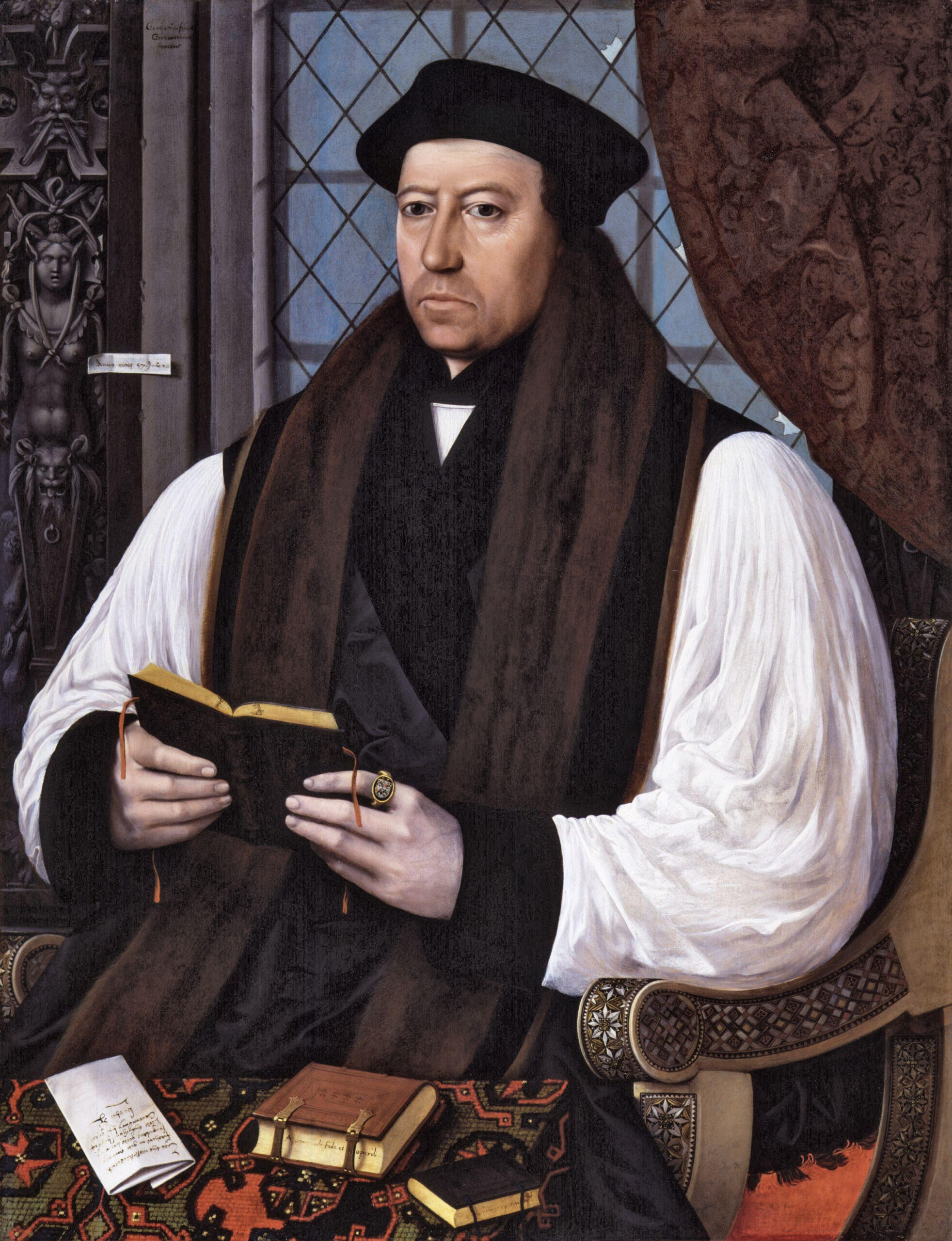
Tommy, Tommy, Tommy. What is there to say? A whole lot, but I’m not sure you haven’t heard it before. When one reads about the life of Thomas Cranmer, it’s hard to not see the way in which relationships were key to how he moved through the world, and maybe harder to divorce his legacy from that of King Henry VIII —a lot harder than it was for Henry to divorce all of his wives.
In 1532, while on the road in Italy, Cranmer received notice that he now occupied the seat of Archbishop of Canterbury, thanks to the woman being courted by Henry, Anne Boleyn. Soon, Cranmer, as Archbishop, would be annulling Catherine’s marriage, excommunicating Catherine, blessing Anne and Henry’s marriage, baptizing their first child, and within three years giving Anne last rites before she was executed for her, it seems, inability to bear a son. Cranmer publicly mourned her death and begged the King not to divorce her. Bless.
By 1543, Cranmer’s quiet leanings toward reform of the Catholic Church and public support and closeness to Henry had provided protection in anti-reform movements, so he began to turn to reforming not just the theology, but the liturgy. On May 27, 1544, we get the great-great-grandfather to our BCP: Exhortation and Litany, a liturgy in English. Eventually there was the need for a more Common Book of Prayer, and in 1549, the first version of BCP was used in worship. By 1552, Cranmer was leading the charge of reform of the Church in England with the Forty-two Articles. It is clear that the pre-teen king didn’t occupy quite as much of his time as his father did.
After Edward’s death in 1553, his sister Mary, a devout Catholic and anti-reformer, took the throne. Within six months, Cranmer was charged with high treason and condemned to death. Cranmer was imprisoned for nearly two years before he recanted all of his writings and works, but it was not enough though this should have saved his life, he was burned at the stake on March 21, 1556. He was killed, but not before he renounced his recantations from the pulpit at the Oxford University Church pulpit. As record has it, as the flames surrounded him, he placed his right hand into the middle of the fire, as it was “the unworthy hand” that wrote the renunciations.
Cranmer’s legacy remains, and there’s much to cover in little time. I didn’t even get to tell you about his not-secret/secret wife at the end of his life that denied his priestly call to celibacy, but that’s for next time.
— Becca Kello
Collect for Thomas Cranmer
Keep us, O Lord, constant in faith and zealous in witness, that, like your servants Hugh Latimer, Nicholas Ridley, and Thomas Cranmer we may live in your fear, die in your favor, and rest in your peace; for the sake of Jesus Christ, your Son our Lord, who lives and reigns with you and the Holy Spirit, one God, now and for ever. Amen.
84 comments on “Richard Hooker vs. Thomas Cranmer”
I had the great privilege of working as an assistant to the general editor of the Folger Library Edition of the Works of Richard Hooker, checking transcriptions of manuscript material, consistency in editorial changes, etc. I was in Iowa, had some Latin, could read secretary hand, had experience in textual editing--the editorial board had been unable to find someone with the needed skills in their old boy coastal networks. So I read a lot of Hooker. I love the Cranmer psalms and collects, but my heart is with Richard Hooker. Oh--and I named my home wifi network "Hooker", until my mother and daughter combined to overrule me.
LOVE IT!!!!
What a great story of getting to work alongside Hooker and his 16th century writings. THanks for bringing us in.
This match up proves that I am not and never was Anglican. (I am batting .250.) First time that I really needed to read the Comments. With your help, I cast my vote for Thomas Hooker. Thank you!
Cranmer seemed to do more for the reform of the Church of England
Both were good, but Thomas Cranmer seemed to do more for the church.
I thought both celebrity bloggers did well today. It was the collect for Richard Hooker that swayed my vote.
In our superb local Renaissance Festival (Crownsville MD), Cranmer is a frequent part of the Henry VIII story line. I'm glad to learn about Hooker now, too
Hooker for the three-legged stool, a precursor to the Methodist's quadrilateral! Apparently, when you add experience to a stool you get a geometric shape.
Next you need someone to prepare a bio for Cranmer, try to find someone who really likes and appreciates the guy. Unparalleled liturgical genius negotiating vicious historical currents that eventually took his life. This writer was very negative and clearly pushed readers into the Hooker camp. Besides, Wesley's realistic fourth theological component (i.e., experience) renders Hooker's trilateral obsolete.
I'm going with Cranmer. When my husband and I were putting together our wedding vows, I spent some time with the 1549 Book of Common Prayer and who can resist "with my body I thee worship, with this ring I thee wed." Cranmer was admittedly an imperfect guy. The things he did for Henry VIII! It was a brutal time, with religious and power all mixed up (sound familiar? White Christian Nationalism, anyone?). I can't imagine facing the tortures of an Elizabethan prison or burning at the stake -- so, yes, he denied him beliefs . . . and then recanted. But the poetry!
Tough choice but Hooker gets my vote for articulating how scripture, tradition and reason work together. It is the very reason Anglicanism makes sense. Hooker sanctified thoughtfulness and made intellectual humility a Christian virtue. Team Hooker!
What an impossible choice! Can't we vote for a tie?
Thomas today for BCP
Every Episcopalian should have a HOOKER FOR JESUS T-shirt. How is it possible not to vote for the carpenter of that three-legged stool? Big shout-out though to Becca Kello for a highly entertaining write-up of Cranmer. Perhaps there is a market for VACILLATING MARTYRS FOR JESUS T-shirts. The ability to write thoughtfully and incisively during a time of political turmoil is a skill we need today. I’m on the corner with the Hookers.
The importance of the middle way swings my vote today
I was baptized Episcopalian, but raised in a non-denominational church. Stopped going to the church in high school and when I returned to the faith in my 40s I chose the Episcopal Church. I read a collection of Episcopal writings, which included Father Hooker, unknown to me previously. I was very impressed with his writings. So for his guidance in my return to the faith, I voted for him.
I agree with you. My return to the faith was also aided by reading the early Anglican theologians.
Would Hooker have answered to "Father Hooker?" I'm not so sure.
@Tully Monster
Tully, oh Tully, tell us your name,
how you became a monster.
Tell us, dear, the source of your game,
else with thee I must remonstre.
St Celia! It is so good to hear from you!
In answer to your question, I am found in central Illinois, I am one of a kind, and someday I hope to be the state's official fossil.
Despite the running joke in my corner of the internet that "Archbishop Thomas Cranmer, deceased" being the standard null choice in every multiple choice poll, I had to vote for Richard Hooker. Via media in all things...
Perhaps had I not watched Wolf Hall I would have voted for Hooker. But as I read today’s write up on Cramer I could not help but visualize his life and struggles. Politics…they were the same then as now and good people are caught up in situations out of their control. But I live the BCP and that is Cranmer’s legacy!
". . .defense of the Book of Common Prayer" and a subdean . . .
- voting for Richard Hooker
I adore the poetic language of the BCP, but Cranmer was just a bit too political. Also, my Kindle wants to call hi Crammed.
I can’t leave my vote for Hooker. The computer will not compute.
Both Hooker and Cranmer were caught up in the religious violence which began in Britain when Henry VIII broke from the Catholic church for wholly selfish dynastic ambitions. Cranmer played a role in Henry's bloodthirsty treatment of wives who couldn't give him a son quickly enough. Thus, my vote is for Hooker. But most of all, I hope this match up shows today's Americans the merciless un-Christian behavior that results from a theocracy run by an autocrat.
Another very tough choice today. I love the BCP and admire Cranmer for his role in developing the Church in England. However, I decided on Richard Hooker for his wisdom and insight into developing the "middle way" as our Anglican theology. I rely on the three-legged stool in my personal approach to our Episcopal theology, and give Hooker full credit!
No one has mentioned Cranmer's recantation-which, oh by the way, didn't prevent his end. Should that factor into my decision?
Today's post about Thomas Cranmer was poorly written. Is there an editor reviewing these posts before they are published? If not, it would be a good precaution.
The hardest vote of this Round! Where would Anglicanism be without BOTH of them? I voted for the Martyr. Speaking "truth to Power" takes real courage and conviction.
This one was dang hard. I love the language of the BCP, both ancient and modern, and for that I am grateful to Cranmer. I also respect his advocacy for Anne, who was innocent of all the charges against her and did not deserve her fate. (I do hope that both she and her daughter will make it into some future bracket.)
In the end, however, it is Hooker who resonates with me. That he should acknowledge God-given reason as critical to the Church--reason that holds both us and Church leadership accountable and acknowledges and adapts to new knowledge about the world, rather than attempting to suppress or hide from it--has been profoundly important to me all my life. And so has tradition. If you lived through the seventies and early eighties, when disgruntled hippies invaded the mainline Protestant churches, decided that beloved hymns and liturgical traditions were boring and outdated, and replaced them with the most awful faux-folk dreck, you know what I'm talking about.
Was that divorce really thanks to Anne Boleyn though, or was it really more to do with Henry, given the power dynamics? Tongue in cheek or no, it feels a little unfair.
Happy to vote for Hooker the Peacemaker over Cranmer the Patron of Appeasement today.
At first glance I liked Cranmer for his celebrity appeal and charisma, years spent rubbing elbows with the rich and famous so he’s still well known. But Hooker gets my vote for solid theology and hard work.
Hooker listed in this order: Scripture first, REASON second, and Tradition last!