
We’ve reached the final week of the Round of 32, and we’re starting it with two of our favs✨
First up is Brother Roger of Taizé, martyred just 25 years ago. He founded the community of Taizé where Christians from every denomination could join in community, pray, and worship together as brothers & pilgrims! You’ve likely heard their form of chant and worship, and if you haven’t, give it a listen on Spotify today! What began with Brother Roger using this as a refuge for people fleeing Nazi persecution has grown into a global pilgrimage site welcoming tens of thousands of young people every year. In fact, Fr. Michael and youth from NYC made the journey themselves… and rumor has it a video might be dropping soon. 👀🎥
In the other corner stands Fr. Damien of Molokai, the priest who didn’t just care for people suffering from leprosy, he chose to live among them. Eventually he even bore the disease himself. Damien didn’t simply admire Jesus’ call to love the outcast, he lived it in the most radical way imaginable. 💛
Two extraordinary witnesses. Two very different ministries. One impossible choice.
Read the blogs. Then cast your vote. 🗳️
P.S. Marina the Monk give it everything she had, but the knight proved too strong. Joan of Arc marches on to the Saintly Sixteen. ⚔️
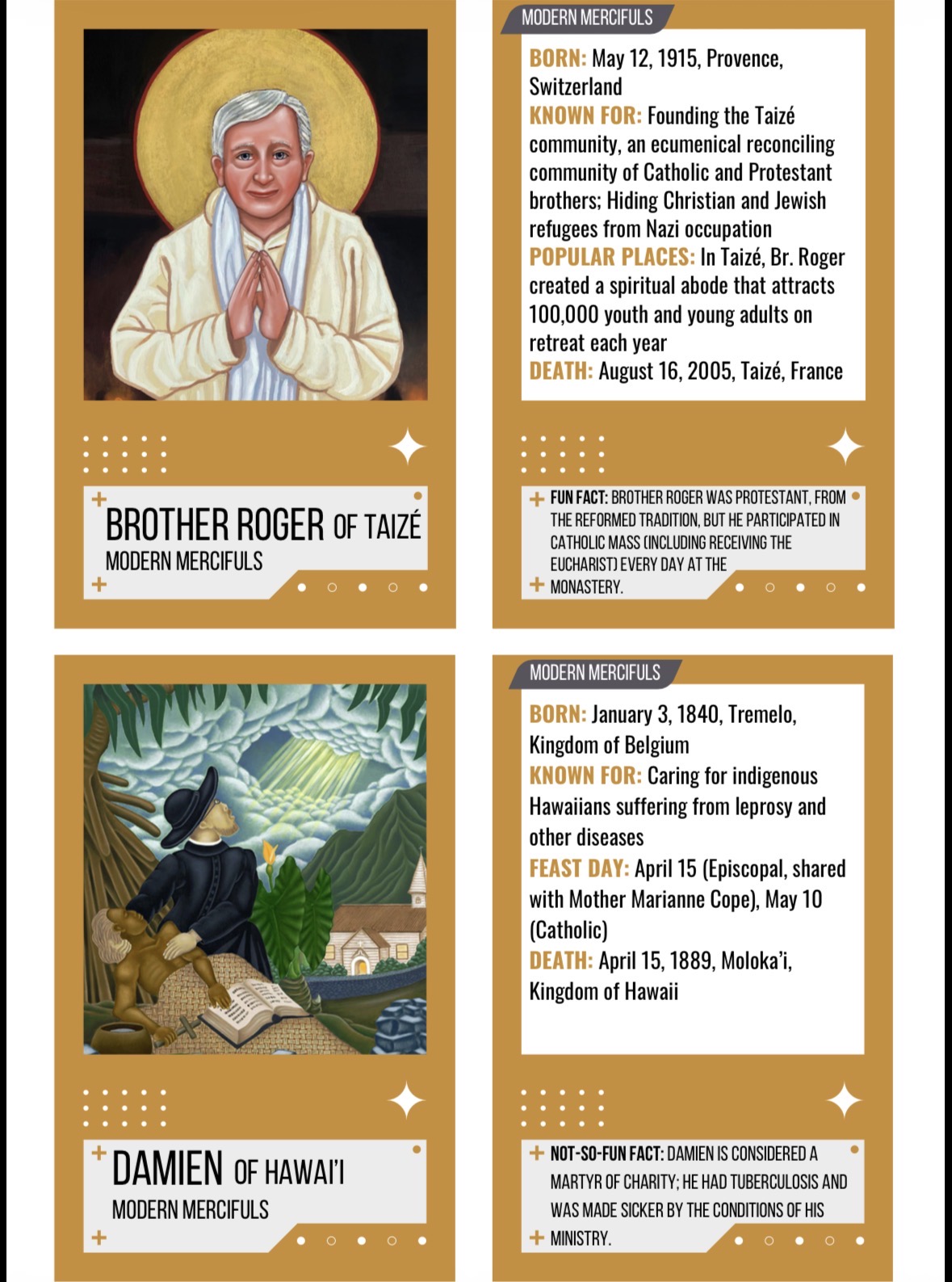
Brother Roger of Taize
Brother Roger of Taizé is a modern-day martyr, a Nazi-fighter, a prolific author, and an uncanonized saint brutally murdered for his non-violent beliefs during worship.
Born Roger Schutz in 1915 in Switzerland, Brother Roger founded the Taizé monastic community in 1940 in Burgundy, France, designed as an ecumenical association. He was the prior of Taizé for 65 years until his public killing in 2005.
As a young man, while studying theology, Roger was stricken with tuberculosis, forcing him into a long convalescence. During this time, he discovered the joys and ways of a monastic life.
At the beginning of World War II, Roger took an initial step by purchasing a home in Taizé, located in unoccupied France. For years, he and his sister hid and smuggled Jews and Christians away from the Gestapo. After the war, the Taizé community grew and welcomed Christian pilgrims of all ages, especially youth.
The community focused on prayer, reconciliation, contemplation, and non-violence. Brother Roger was dedicated to ecumenism among the many Christian factions. His focus was often Christian youth.
Brother Roger lived a quiet, simple life, steeped in prayer and centered on Christianity. He was friends with Mother Teresa and met with various popes including Pope John Paul II.
On August 16, 2005, Brother Roger was stabbed to death in the chapel while deep in meditation during evening prayer. His murderer was a mentally ill Romanian woman. In a twist of fate, she, too, was stabbed in 2011.
His funeral attracted religious and secular dignitaries including the President of Germany and the Minister of the Interior of France. The funeral was presided by a Catholic cardinal, the president of the Vatican's Pontifical Council for Promoting Christian Unity. So many attended that screens were erected outside the church for the thousands who gathered.
Brother Roger’s writings focused on prayer, reflection, and Christian spirituality. His publications list is extensive, starting in 1944 and includes three written with his friend Mother Teresa: Mary, Mother of Reconciliations; Seeking the Heart of God; and Meditations on the Way of the Cross.
His many honors are equally impressive, among them Archbishop Rowan Williams’ Lambeth Cross for Ecumenism; the John Templeton Foundation Templeton Prize; and the UNESCO Prize for Peace Education.
While no particular date is set for him, the Taizé Community and some Anglicans and Episcopalians commemorate him on the anniversary of his death on August 16.
— Neva Rae Fox
Collect for Brother Roger of Taize
O God, whose blessed Son became poor that we through his poverty might be rich: Deliver us from an inordinate love of this world, that we, inspired by the devotion of your servant Brother Roger., may serve you with singleness of heart, and attain to the riches of the age to come; through Jesus Christ our Lord, who lives and reigns with you, in the unity of the Holy Spirit, one God, now and for ever. Amen.
Damien of Hawai'i
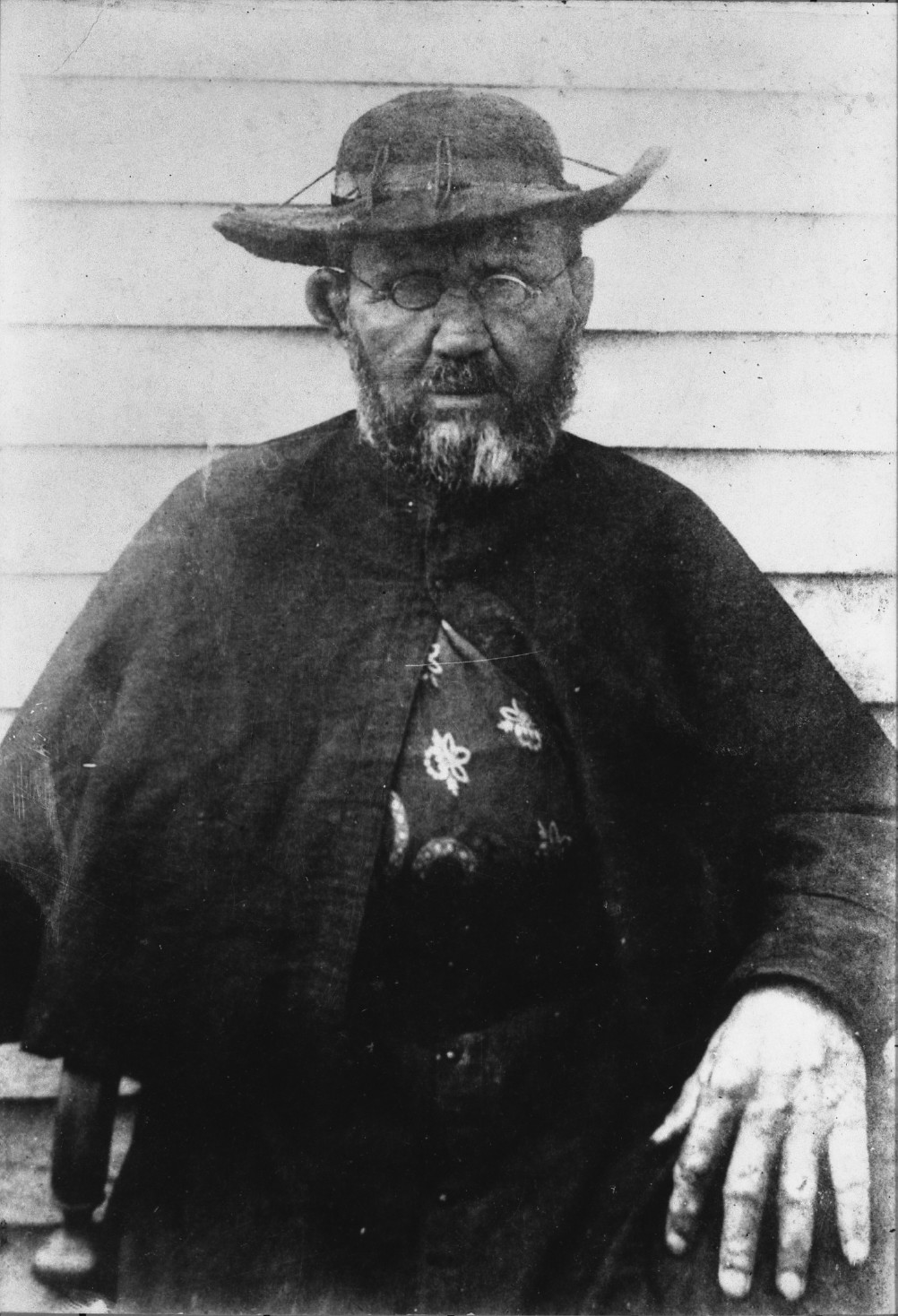
Born Joseph de Veuster in Belgium in 1840, Damien was the youngest of seven children. He was a precocious child who cared deeply for his family. He attended college at Braine-le-Comte and joined the Society of the Sacred Hearts of Jesus and Mary in 1858. Damien was eager for a hands-on mission that would offer personal connection rather than more schooling. The opportunity came in 1863 when his brother, also a priest, became ill and was unable to travel. Damien, not yet ordained, volunteered to replace his brother and chose to leave his family for the Sandwich Islands (modern-day Hawai’i). His request was eventually approved, and in 1864, he arrived in Hawaii and was ordained that same year. Once in Hawaii, Damien became a traveling priest, setting up temporary altars and calling the faithful to Mass with a conch shell. Years later, another volunteer opportunity to serve the much-neglected leper colony on Molokai would change his life.
Arriving on Molokai on May 10, 1873, his eventual feast day, Damien faced his greatest challenge. The strict exile rules for the infected left the island lacking basic infrastructure. Damien immediately began overhauling the village and its inhabitants, building a church and community dwellings and establishing a clean water system, all while calling people to faith. He would advocate repeatedly for his community, serving as both pastor and physician. He demanded resources from his superiors, giving him a reputation for obstinacy. With limited resources, he chose to share equally among all in the colony, ignoring denominational differences in favor of humanity. Damien’s improvements to the island buoyed those infected and fostered a true connection, as they shared food, music, and faith. While it is undeniable that Father Damien enriched the lives of those he touched, in doing so, he also repeatedly exposed himself to the disease. He followed Christ’s example, ignoring quarantine protocol and eating from the same pot, even sharing the occasional pipe with his community.
Father Damien continued to treat the lepers of Molokai with decency and respect, living five years with leprosy before his passing in 1889. In the wake of his death, there was an immediate call for his sainthood, which wouldn’t come until over a century later in 2009. While his moral heroism was irrefutable, even to his detractors, some remained unconvinced of his holiness, an accusation that would be repeatedly disproven. In truth, Father Damien’s example teaches that there is joy to be found among hopelessness, and beauty to be found in misery. Through his sacrifice, Damien serves as a real-world example of how to embody Christlike characteristics. His eventual canonization would bring to Rome a cultural fusion of pilgrims, predominantly from Belgium and Hawai’i, continuing to build community around unlikely companions.
— Tori Proctor
Collect for Damien of Hawai'i
Bind up the wounds of your children, O God, and help us to be bold and loving in service to all who are shunned for the diseases they suffer, following the example of your servant Damien, that your grace may be poured forth upon all; through Jesus Christ our Lord, who with you and the Holy Spirit lives and reigns, one God, for ever and ever. Amen.
80 comments on “Brother Roger of Taize vs. Damien of Hawai'i”
The music of Taize, and Taize style worship, have brought so much meaning to me, I have to vote for Brother Roger today. But I expect Damien to win, and won't argue if he does. These are two of the best, a shame they come up against each other in the first round.
I love the music of Taize and have great respect for Brother Roger. However, the first line of the Nominationtide rules reads:
"The nominee must be on the official calendar of saintly commemorations of some church."
The blog states that Roger is not on an official calendar.
How does he qualify?
The blog states that he is included in Episcopal/Anglican calendars on Aug. 16, the day of his martyrdom.
I greatly admire Brother Roger and the community of Taize; I have voted for him today.
But I think the description here uses "martyr" in a slightly confusing way. He surely was a "witness" to Christian faith, and died in that witness. But his assailant was so mentally afflicted that she could not be held legally accountable for her act, or blameworthy (in need of forgiveness) by the community which mourned their beloved prior. That tragic inexplicability does not in any way undermine the faithful integrity of Brother Roger's life and death--but I would not include him among Christian "martyrs," in its common usage of those killed intentionally from hostility to their faith.
I never look at the results before I vote. Father Damien has been in Lent Madness several times before, and I'm sure he has a faithful following. I did, in fact, expect him to be ahead. But I voted for Brother Roger. I have heard of Taizé, and even had the opportunity to attend an evening service once; but I had no idea of its history or of the impressive life and tragic death of Brother Roger. I would, however, like to compliment Tori Proctor for spelling Hawai'i correctly.
An impossible choice today. My vote went to Brother Roger, for his quiet heroism in occupied France, for all the young people who have been influenced by his life and teaching, and because my visit to Taizé many years ago had such a profound impact on me.
If you ever get a chance to go on retreat at Taizé, take it. It is a grace-filled place.
Totally unfair matchup. Almost didn't vote. Great tributes to two great saints!
I chose Roger for smuggling Jews and Christians out of danger, for his commitment to ecumenism, and for his lasting influence on so many people, especially ypung people. Damien was heroic but might have continued his life of service if he hadn't chosen to eat from the same pot and share a pipe with lepers. Hansen's disease isn't spread easily, not by living with infected people or by hugging them, only by contact with droplets from the nose or from a cough.
No mention of the music used at Br Roger's Taize community? Very simple and singable! Worth checking out.
Not to diminish the work of Fr. Damien and his work on Molokai, but the work of Roger of Taise continues today bringing help and peace to all. I go to the service frequently as presented in my home church. So for the continuing effect from Roger's work and the ongoing use of the Taize service, my vote goes with Roger.
This is the last time I'll speak up about this, and then I'll drop it (until next year, or whenever another transgender saint is nominated). Marinos the Monk gave it everything HE had. Joan of Arc dressed as a man; Marinos lived as a man. His entire adult life. We should respect that.
I'm glad that's done. I get so tired of ancient people being stuffed into modern concepts that did not exist back in their day just to satisfy someone's present-day agenda.
I arrived to choose Roger and Taize. I am leaving voting for Damien because of the collect: Bind up the wounds of your children…
I am honestly not sure now who I voted for because both are incredibly worthy. Wow! Either way these were two very remarkable people worth studying and learning more about and from!
Brother Damien helped the lepers of Molokai, but Brother Roger gave us Taize, a sacred practice that feeds the hearts of everyone who experiences it. His recognition as a saint is long, long overdue.
We have a Taize service twice a month at All Saints Episcopal Church in Salt Lake City, Utah, thanks to Father Trace Browning and our music director, Marlin J Haws. It is my favorite service.
I, of course, voted for Brother Roger of Taize.
Brother Roger of Taize all the way! I get a frisson of joy every time I hear the word Taize... because the beautiful, contemplative form of prayer and chanting they've shared around the world is one I've often found to be both grounding and soaring, at the same time. I love it. And... being from Minneapolis, Brother Roger's active resistance to in-his-face fascism is... more resonant than I'd like to say. What an inspiration he is!
I did not vote for Brother Roger because his community has morphed into a gay-unfriendly community.
It truly breaks my heart to be unable to vote for Roger of Taize as well -- Taize music deeply enriches my own spirituality, and before he founded a vision and model for ecumenism and global unity, he resisted fascism!
However, I was born on Moloka'i, so Damien had to get my vote! ... A bit of Moloka'i geography and history: Kalaupapa Peninsula, where the former leper colony was, is a tiny peninsula jutting out of the rugged north coast of the island, below steep volcanic cliffs. The much larger southern part of the island of Moloka'i includes ranchland, farmland (much of it overfarmed by former sugar and pineapple cultivation), and tropical forests. Most of its people are of Hawaiian descent, and the island is rich with Hawaiian music and culture. Over 7.300 people live on the island; the population of Kalaupapa peaked at about 1,000 before quarantine was finally abolished in 1969.
My family moved back to O'ahu before I turned two, but not before first my sister and then I were baptized in the newly-built Grace Episcopal Church, Ho'olehua -- my sister's baptism was their first! However, I've visited Moloka'i a few times over the years, including the somewhat terrifying mule ride down the cliff (and then back) to Kalaupapa, with a historic tour led by former Hansen's disease (formerly called leprosy) patients, including Damien's grave and the church he built. Alan Brennert's well-researched historical novel Moloka'i, spanning almost a century following Damian's death, is a fascinating and heartbreaking read about his legacy in Kalaupapa, a place long devoid of hope.
There seems to be a lot of contempt and dislike among younger, newly converted Catholics (especially men) for the Anglican Communion, especially following the appointment of Archbishop Mullally. There is a definite need for the influence of the Taizé community and its ability to build bridges between young Catholics and Protestants that are wide, easily navigated, and bidirectional. That said, I'm still voting for Father Damian.
I first learned about Father Damian and the colony on Molokai as a child, reading my grandmother's (now very fragile, but beloved) edition of war journalist Ernie Pyle's posthumously published *Home Country,* a kind of precursor to the travelogues of Charles Kuralt. Pyle spent two weeks in Kaluapapa, which had by then been transformed into a kind of self-contained paradise through the hard work of Father Damian, those who came after him, and--above all--its own residents, most of whom were native Hawai'ians.
Before that, I knew only of "lepers," who seemed, from the Bible, to have been terrifyingly, fatally cursed by God and, to my shame (and that of the Biblical scribes), not entirely human. Pyle provided a fascinating, humanizing account of real, flesh and blood people making the very best of living with what was at the time a terrible, disfiguring disease and a life sentence in isolation with progressive loss of function.
Now, we know Hansen's disease to be both easily prevented (armadillos, for instance, are cute, but don't handle them) and cured, but at the time, Father Damian must have known his own eventual fate.
Pyle's Letters from a Leprosy Colony (https://archive.org/details/lettersfromlepro00pyle/page/6/mode/1up?ref=ol) describe the colony as it was in 1937-38. But Robert Louis Stevenson's impassioned advocacy for Father Damian is particularly moving. (RLS received treatment for TB in upstate New York and knew what it was to suffer from a potentially deadly, highly communicable disease.) I'm guessing we'll hear more from him in the next installment of Father Damian's story (assuming he wins this round).
Although I couldn't vote for Damien, I'm pleased he's ahead!
I first heard of Damien in Lent Madness a few years ago and was very disappointed he lost. I love the Taize worship, and what it embodies,but I'm still a fan of Damien's example of Christlike love.
It's all about the match-ups and the tone of the biographies. This pairing contributed to the difficulty of weighing my vote. Both inspire
Okay Team Damien of Molokai, time to show up and show out. Get out the vote and start the march to the Holden Halo
Very difficult choice! Both are very deserving men and examples of how to live.
My aunt taught school in Hawaii in the 50's. People held Damien in great reverence. People still talked about the sermon he preached as soon as he was diagnosed, beginning with the words "We lepers..." He demonstrated great love for people who had been ostracized as unclean for thousands of years.
Brother Roger was a remarkable man. After the war he ministered to the German soldiers imprisoned in the Taize area. When he was in your presence you could sense love & warmth.
Another impossible choice!! Both of these men exhibited faith, sacrifice and love for their fellow human beings. I voted for Fr. Damien, but will not be sad with whomever wins.
Many of today’s voters refer to practicing, witnessing, experiencing Taize music and chants - something here and now. Not so with Father Damien and his fellow lepers. I wonder how many of us would walk beside Father Damien….
I voted for brother Roger today because I so love his body of work. Even so, I felt a debt to father Damien because I voted for another Damien last week thinking it was him. This is the saintly man who lived with the lepers and inspired Damien Ministries in Washington DC to serve people with AIDS in his memory in the 1980s. Tough choice today!
I voted for Brother Roger because he smuggled Jews & Christians and hid them from the Gestapo. He was a French freedom fighter against the Hitler & the Nazis.