
The Hospitallers are celebrating today after Blessed Gerard just eeeked out a win over Julie Billiart 53.85% to 46.15%, making the Order of St. John proud and proving once again that medieval hospital administrators still know how to win a close one.
But now we arrive at the final matchup of the first round!
Today it’s Constance and Her Companions vs. the Martyrs of Uganda.
Constance and her companions come to us from Memphis, where these brave sisters nursed the sick and cared for victims of yellow fever, ultimately giving their lives in service to others.
Across the bracket stand the Martyrs of Uganda, a remarkable group of young Christians, both 🏴Anglican and Roman Catholic🇻🇦 who refused to abandon their faith and paid the ultimate price for their witness.
Care for the sick vs courage before a king. Martyrs of Memphis vs Martyrs of Uganda.
Only one can claim the final ticket to the Saintly Sixteen. Read the blogs, watch the video, and cast your vote! 🏆
Constance & Her Companions
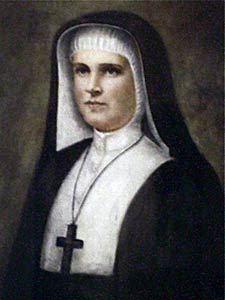
The individual names of the Martyrs of Memphis, except for Constance, might not come to mind quickly, but these holy women and men are well-known for living their lives in Christ and in service to others.
Since Memphis, Tennessee, is located on the Mississippi River, the city and other major hubs along the river’s route were prone to occasional outbreaks of yellow fever, a virus spread by mosquitoes. But August 1878 was different – the epidemic was worse and the impact more severe.
Evacuations were enforced; thousands fled the city. But many could not leave, thereby forcing them to take their chances amidst the epidemic. The death toll rose each day, often reaching 200+.
Despite obstacles, some dedicated caregivers chose to risk their own health and stay in Memphis. Those included episcopal nuns of the Community of Saint Mary, led by Sister Constance, and two clergy colleagues. Of them, only one was trained as a nurse.
Sister Constance, Sister Thecla, Sister Ruth, Sister Frances, the Rev. Charles Carroll Parsons, and the Rev. Louis S. Schuyler are the Martyrs of Memphis. There were two survivors among the caregivers: the Very Rev. George Harris, dean of the cathedral; and Sister Hughetta.
The Sisters were newcomers to Memphis, having just arrived in 1873 to organize a girls' school at the Cathedral. But in 1878, their ministry shifted to meet the needs of a sick and dying community.
Based at the Cathedral, located in the heart of the epidemic area, and battling heat, humidity, and their own illness, Constance and her companions tended to the sick, cooked and served food, offered water to the thirsty, organized relief efforts, and provided homes for children whose parents had died in the epidemic. It did not matter who was in need - how rich or how poor or what nationality – all were treated.
Their compassion was tireless.
Constance, the convent's superior, was the first to succumb, on September 9. Her companions followed quickly.
The six Martyrs of Memphis are buried at Elmwood Cemetery in Memphis. The high altar in St. Mary’s Cathedral is a memorial to the four Sisters.
The Martyrs of Memphis are commemorated on September 9. Not surprisingly, they are the patron saints of those who provide service to the sick and dying.
— Neva Rae Fox
Collect for Constance & Her Companions
We give you thanks and praise, O God of compassion, for the heroic witness of the Martyrs of Memphis, who, in a time of plague and pestilence, were steadfast in their care for the sick and dying, and loved not their own lives, even unto death; Inspire in us a like love and commitment to those in need, following the example of our Savior Jesus Christ; who with you and the Holy Spirit lives and reigns, one God, now and for ever. Amen
Martyrs of Uganda
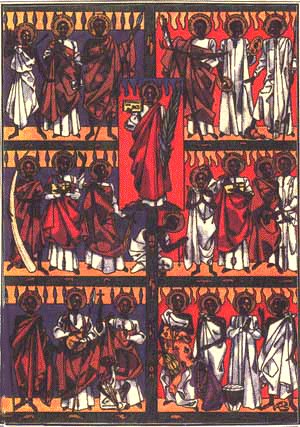
Judging by sheer numbers, today’s matchup isn’t even close. The Ugandan martyrs are 23 Anglicans and 22 Catholics killed by state violence between January 1885 and January 1887.45 saints to 1.Pretty good odds. However, the story of the Ugandan martyrs is complex, inviting prayerful discernment instead of easy comparisons or obvious answers.
Christianity came to the Kingdom of Buganda (the central region of modern Uganda) in 1877 through the work of the Church Missionary Society. These Anglican missionaries were soon followed by Roman Catholic missionaries, joining recently arrived proponents of Islam. The court of the King of Buganda became crowded with converts to each of these three traditions, who — at least at times — seemed to be vying for power and influence.
King Muteesa I, who ruled until 1884, was tolerant of Christianity. His son, Mwanga II, was initially in favor of Christianity, but eventually ordered the murder of a bishop from England and dozens of Ugandan Christians.
The historical record is ambiguous. Were these killings religious persecution? Were they politically motivated? A little of both? Answers are complicated by the sinfulness of European colonialism operating in Africa at the time (and still operating in all its neo-colonial guises today). The first missionaries to Buganda were no doubt entangled in the project of British imperialism, and Europeans used the martyrdoms as colonial propaganda. Does this negate the martyrdom of native Ugandans? Does the sinfulness of a congregational leader somehow lessen the authenticity of a congregation’s faith? Absolutely not, thank God (let every imperfect clergy person say, “Amen”).
It seems that some of the Ugandan martyrs were killed because they defied the king on matters of sexual ethics. Apparently, the king felt he could sleep with whomever, no matter their age. Certain Christians objected and were killed. It is also clear that the faith of those killed was central to their identity and to the witness toward God’s grace and forgiveness, which they, by all accounts, demonstrated at the end of their lives.
Sainthood is often ambiguous, if we’re honest. Even seemingly unexceptional Christian faithfulness gets complicated in the midst of average lives lived in this broken world. And yet, to our surprise and sometimes disgust, God undeniably keeps using ordinary, complicated, flawed people. God even uses us if we let it happen. God keeps on working during morally ambiguous times and under complicated political circumstances; God’s grace and providential purposes still shine through for those who look. God shows up, people are healed, lives are transformed by the Gospel, and sometimes average Christians choose to give up their lives for the sake of Jesus. In our place and time, this is a mystery worth contemplating.
— James Stambaugh
Collect for Martyrs of Uganda
O God, by whose providence the blood of the martyrs is the seed of the church: Grant that we who remember before you the blessed martyrs of Uganda, may, like them, be steadfast in our faith in Jesus Christ, to whom they gave obedience even to death, and by their sacrifice brought forth a plentiful harvest; through Jesus Christ our Lord, who lives and reigns with you and the Holy Spirit, one God, for ever and ever. Amen.
60 comments on “Constance & Her Companions vs. Martyrs of Uganda”
With all respect for your hard work, at the end of this first round, I have to say that I strongly dislike the way the last couple of Lent Madness brackets have relied heavily on these corny "duplicate/matching" saint pairs.
It was fine when it popped up once or twice in a bracket, as a fun little joke, but at this point it seems like the entire first round is constructed this way. It makes the pair of descriptions for each day feel repetitive ("Saint B was also associated with dogs, but here's how they were different from Saint A..."), it denies the saints a chance to compete fully on their own merits, and it locks out potentially diverse and interesting lesser-known saints in the first round, before we've had a chance to learn more about them.
(For example, look at Marina the Monk being forced to compete against Joan of Arc in the first round last week. A really fascinating saintly figure who deserves more recognition was reduced to being that day's less-popular "saint who defied gender norms", with almost no chance of defeating one of the most popular saints of all time.)
Honestly, I would like to see LM move back towards a less deliberately-constructed, more randomly-seeded bracket in general. It stops feeling like a real vote-off when the matchups are so obviously selected on purpose. I understand that the subcategories of saint were created to offset the voter bias towards recent historical figures, and I'm not going to push back too hard on them, but -please- consider reducing the themed-pairs thing next year?
I was a boy in Memphis; and have prior generations of family that were impacted by the yellow fever epidemics there. Sister Constance and the others have a special place in my heart.
Were the proponents of Islam who went to Uganda participating in European colonialism? Is it a sin to follow Jesus' command to go out and make disciples of all nations?
I want to protest this trend of multiples. It is hard enough to choose 1, but groups just seem unfair.
Faith is often ambiguous and contested as illustrated by the Martyrs of Uganda. Whilst I do not doubt their sincerity or their faith, the weaponisation of human sexuality in the Anglican Church today is too raw to allow me to vote for them. My vote goes to the courageous and compassionate Martyrs of Memphis.
As a 1966 graduate of St. Mary's School in Memphis, founded but Constance and her sisters, there was only one choice. Would that I could be so self-giving and courageous if facing a similar situation.
This is an incredibly tough choice. Being a medical person I am drawn to those who cared for anyone in a plague or epidemic. The work can seem never ending and mind numbing. And yet what happened in Uganda is also about bullies with power and those who stood up against them, and I cannot abide bullies. The comments of others helped me a great deal in making this decision between two worthy groups.
The Martyrs of Uganda got my vote as being relevant in today's challenging political climate. They held fast to Christian values in the face of a king with political authority and self-serving personal practices.
I had never heard of COnstance and her COmpanions, but I am always glad to vote for "Americans," since we so seldom appear here.
I admire that they chose to remain and help, even thugh they must have known it was almost certainly a death sentence.
The story of the Ugandans misses some key aspects. The king was fond of dallying with the page boys in his court. Several of them, encouraged by the missionaries defied the king's advances and were put to death by him. This story is frequently cited in modern Uganda as justification for the intense homophobia which characterizes Ugandan politics. I voted for the Memphis Companions.
Another difficult decision today! This year's Bracket has been one tough choice after another. Given our recent pandemic experience, and as a nurse, I had to vote for Constance and her companions. However, I deeply admire those who stand up against State bullying and perversity, and I honor the Ugandan martyrs. If only we all have the courage to do the same here today.
I voted for Constance because care for the sick and dying is always needed. However, James Stambaugh's last paragrahp "And yet, to our surprise and sometimes disgust, God undeniably keeps using ordinary, complicated, flawed people. God even uses us if we let it happen. God keeps on working during morally ambiguous times and under complicated political circumstances; God’s grace and providential purposes still shine through for those who look. God shows up, people are healed, lives are transformed by the Gospel, and sometimes average Christians choose to give up their lives for the sake of Jesus. In our place and time, this is a mystery worth contemplating" is one of the best writings on God's grace that I have seen in a long time.
Thoughtful comments all around. Thank you. I did not incorporate a lot of facts into my article because I found it difficult, if not impossible, to separate the facts from the propaganda later used by European governments to justify their colonization of what is now Uganda and their attempts to destroy its indigenous culture. I’ve also been reflecting about how I find it more difficult to accept pious legends when they originate in recent history. Had I been writing about a saint like Brigid or Aidan from the distantly medieval “golden age” of saints, I might be more straightforwardly accepting of “legendary” elements of their hagiography than I would of unverified or unverifiable information about 19th century saints. The politics of colonialism is shaping my view here, but of course the real politics facing ancient saints of the British Isles was surely no less complicated, so I don’t know. I wrote what I wrote, then I voted for Constance and her companions….
I had to vote for Constance. My sister-in-law's name is Constance and she is a doctor.
My husband and I were married in a civil ceremony right before I started seminary at Sewanee. We had had a church wedding planned but had canceled it after our scheduled officiant got embroiled in some unfortunate family turmoil involving objections to our marriage. With the "non-objection" of my bishop, we proceeded with the marriage in a civil ceremony, with a promise to have a church ceremony later (the Blessing of a Civil Marriage from the BCP).
We had wanted our first act as a married couple to be receiving communion, but that wasn't possible in our "justice of the peace" ceremony, so on the way back from the county offices in Winchester, we stopped at the Convent of St. Mary in Sewanee for Evening Prayer and afterwards, asked if they could serve us communion from the Reserved Sacrament. They were somewhat familiar with our story and the heartbreak of having had to cancel our church wedding relatively last-minute.
"Oh, yes," the sister said to our request as to whether she could serve us communion, "and we'll even get out our special chalice for you!"
Shortly afterwards, she emerged with a solid gold chalice that had been used by the Martyrs of Memphis to serve communion to the dying in the yellow fever epidemic. The sisters did not survive, but their chalice did, and we were blessed to receive the blood of Christ from it on our first day as a married couple. Ever since then I have had a special place in my heart for Constance and her Companions!
Again, it was difficult to decide between these two groups of saints.
At this point, Constance and her Companions are winning today’s poll, and they are deserving. I nearly voted for them as well.
That said, I would also like to learn more about the Martyrs of Uganda and also followed the links commenters provided. James wrote that “God keeps on working during morally ambiguous times and under complicated political circumstances; God’s grace and providential purposes still shine through for those who look. God shows up, people are healed, lives are transformed by the Gospel, and sometimes average Christians choose to give up their lives for the sake of Jesus.”
As an “ordinary” working class child of parents who raised us to keep growing increasingly aware of and to share the benefits we have in a generally wealthy society, for which multitudes of other “ordinary” people have suffered and died, I voted for the Martyrs of Uganda.
I had not heard of their lives and witness in the face of abusive power before and hope to continue learning more and to better do my small share in our collective work to break through the normalization of colonial violence.
Growing ever more open to the truth of our connectedness with all in God - no matter how seemingly distant or different- is how we can be more equipped to share in God’s joyful work of healing together with those who have suffered the damage done by the “normal” kingdom of this world.
Thanks again to this community for continuing to foster justice, kindness, humility and healing through more of such connections.